
The fear that weed has been laced — secretly mixed with another drug — is common, and it spikes every time a story about contaminated cannabis goes viral. The reality is more nuanced than the rumors: deliberate lacing of cannabis with hard drugs is reported far less often than people assume, but contamination and adulteration do happen, especially in unregulated markets, and some of the signs are worth knowing. The most important thing to understand first is that you usually cannot confirm lacing by looking at the flower — and if you feel seriously unwell, that matters more than any inspection.
How common is laced weed, really?
Deliberate lacing — a dealer secretly adding a drug like cocaine, methamphetamine, PCP, or fentanyl to cannabis to make it stronger or more addictive — is widely talked about but poorly documented. Public-health agencies and drug-checking services report that it happens, but far less frequently than the stories suggest, and many supposed cases turn out to be something else: unusually strong cannabis, a different strain than expected, synthetic cannabinoids sold as cannabis, or contamination with pesticides, mold, or cutting agents rather than a second drug.
That distinction matters for two reasons. First, panic about rare events distracts from the common risks — mold, pesticides, and poor quality control in unregulated markets cause real harm far more often. Second, the response is different: suspected fentanyl exposure is an emergency, while moldy flower is a reason to throw the product away and buy from a safer source. Our guide to what moldy weed looks like covers the contamination side in detail.
Warning signs in the flower itself
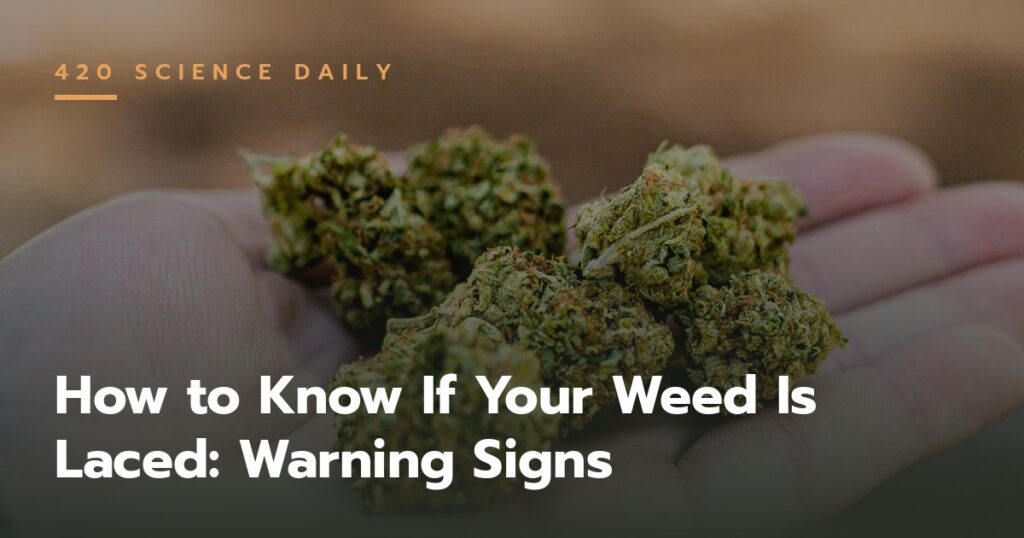
Normal cannabis flower has a recognizable look: green to purple buds, visible trichomes (the frosty resin glands), orange or brown hairs, and a herbal, skunky, or piney smell. Things that should make you suspicious include:
- Unusual crystals or powder. Trichomes look frosty and sticky under magnification. A separate white powder, glassy shards, or gritty crystals that do not match the bud’s texture are a red flag.
- Chemical or plastic smells. Cannabis smells herbal and pungent, not like chemicals, fuel, or plastic. A strong chemical odor is a reason not to use it.
- Odd texture or weight. Flower that feels wet, gritty, or oddly heavy may have been sprayed or treated with something.
- Harsh, chemical taste. A sharp chemical or metallic taste that is nothing like normal cannabis smoke or vapour is a warning sign.
- Residue on your fingers or grinder. Sticky resin is normal. A coloured powder or crystalline residue that is not resin is not.
None of these signs proves lacing — strong fertiliser residue, poor curing, or synthetic cannabinoids sprayed onto plant material can produce similar clues. But any of them is a good reason to stop, not use the product, and get it from a safer source instead.
Warning signs in how it feels
This is where people usually notice something is wrong — the effects do not match cannabis. Effects that should worry you include:
- Far stronger or longer than expected from the amount you used, especially if you know your usual tolerance.
- Hallucinations or dissociation — seeing things, feeling detached from your body, or losing track of reality. Cannabis can cause anxiety and, rarely, paranoia, but frank hallucinations are not a normal cannabis effect.
- Racing heart, chest pain, or trouble breathing. Cannabis can raise heart rate mildly, but chest pain or breathing difficulty is not normal and needs urgent assessment.
- Numbness, tingling, or loss of coordination beyond ordinary cannabis effects.
- Extreme agitation, confusion, or aggression that is out of character for you.
- Seizures, collapse, or loss of consciousness. These are emergencies, full stop.
Remember that cannabis itself can cause anxiety, paranoia, and a racing heart, especially at high doses or in new users — which is why our explainer on why weed makes some people paranoid is worth reading before assuming the worst. The difference is degree and kind: ordinary cannabis discomfort passes and stays within the range of anxiety and unease, while lacing effects tend to feel categorically different — hallucinations, numbness, or physical symptoms that do not fit cannabis at all.
What substances actually turn up?
| Substance reported | Why it matters | How often it is found |
|---|---|---|
| Synthetic cannabinoids (e.g. “spice” sprayed on plant material) | Far stronger and less predictable than cannabis; linked to seizures and hospital visits | The most commonly reported adulterant in drug-checking data |
| PCP | Hallucinations, dissociation, agitation | Reported, but uncommon |
| Methamphetamine / cocaine | Stimulation, racing heart, agitation | Reported occasionally; often rumor rather than confirmed |
| Fentanyl | Opioid overdose risk — slowed breathing, unconsciousness, death | Rarely confirmed in cannabis flower itself, but the consequences are so severe that any suspicion is treated as an emergency |
| Pesticides, mold, heavy metals | Breathing problems, nausea, long-term health risks | Common in unregulated markets — the everyday contamination risk |
The fentanyl row deserves emphasis. Confirmed cases of fentanyl in cannabis flower are rare, but fentanyl is so potent that drug-checking services and public-health agencies treat any suspicion seriously. If you have any reason to think fentanyl is involved and someone is unresponsive or breathing slowly, treat it as an opioid overdose: call emergency services and use naloxone if it is available.
What to do if you think your weed is laced
- Stop using it immediately. Do not try to “test” it by using more.
- Do not use alone. Stay with someone who can call for help if you worsen.
- If symptoms are serious, call emergency services. Chest pain, trouble breathing, seizures, hallucinations, or loss of consciousness are emergencies. Tell responders honestly what you took — they are there to treat you, not to punish you.
- Keep the product and packaging. Do not throw it away if you can avoid it — it may help clinicians or drug-checking services identify what was in it.
- Use a drug-checking service if one is available near you. These services can test a sample and tell you what is actually in it. Availability varies by country and region.
- Change your source. Licensed, regulated dispensaries test their products for contaminants and potency. Unregulated sources do not, and that is the single biggest risk factor.
Can drug-checking services help?
Drug-checking services exist in a growing number of countries and regions, and they are the closest thing to a real answer when you suspect adulteration. Typically, you bring a small sample, and the service uses lab equipment — reagent tests, spectrometry, or test strips for specific substances like fentanyl — to tell you what is actually present. Results are usually anonymous, and many services also explain what the findings mean for your safety. Availability varies enormously: some cities have walk-in services and mail-in options, while other places have none at all, and the legal status of checking services differs by jurisdiction. If one exists near you, it is worth knowing about it before you ever need it, not after. Even a fentanyl test strip, where legally available, can rule out the single most dangerous possibility, though strips have limits — they detect fentanyl specifically, not every adulterant, and a negative strip does not make a product safe.
How to reduce the risk in the first place
The most effective protection is boring: buy from licensed, regulated sources where products are lab-tested and labelled. Beyond that, know your source, avoid products with no labelling or packaging, inspect flower before use, and be especially cautious with pre-rolled products, where you cannot see what is inside. If you grow your own, you control what goes into the plant — and learning basic plant care, like when to top weed plants, is part of growing clean flower. Growing your own also removes the question of what a dealer may have added. And if flower quality in general worries you, learning what moldy weed looks like and what healthy trichomes look like makes inspection a habit rather than a panic response.
Frequently asked questions
Can you tell if weed is laced by looking at it?
Not reliably. Some signs — strange powders, chemical smells, gritty crystals — are suspicious, but many adulterants are invisible, and normal trichomes can look crystalline to an untrained eye. Visual inspection can raise suspicion; it cannot confirm safety.
Does laced weed taste different?
Sometimes. A harsh chemical, metallic, or plastic taste is a warning sign. But taste is subjective, and some adulterants have no taste at all. An odd taste is a reason to stop, not a diagnostic test.
Is laced weed common?
Deliberate lacing with hard drugs is reported much less often than rumors suggest. Contamination with pesticides, mold, and synthetic cannabinoids in unregulated markets is the more common real-world problem.
What should I do if a friend collapses after smoking?
Call emergency services immediately. If they are breathing slowly or not at all and you suspect an opioid may be involved, use naloxone if available. Stay with them, tell responders what was taken, and do not leave them alone.
Can drug tests detect laced weed?
Standard drug tests check for specific substances, not for “lacing” in general. A drug-checking service can analyze a sample directly, which is far more informative than a urine test after the fact.
Sources
- Centers for Disease Control and Prevention (CDC) — synthetic cannabinoid and fentanyl public-health information.
- National Institute on Drug Abuse (NIDA) — cannabis contaminants and adulterant reporting.
- Drug-checking services’ published findings (e.g. DanceSafe, Energy Control) — what adulterants are actually found in samples.





3 responses to “How to Know If Your Weed Is Laced: Warning Signs”