
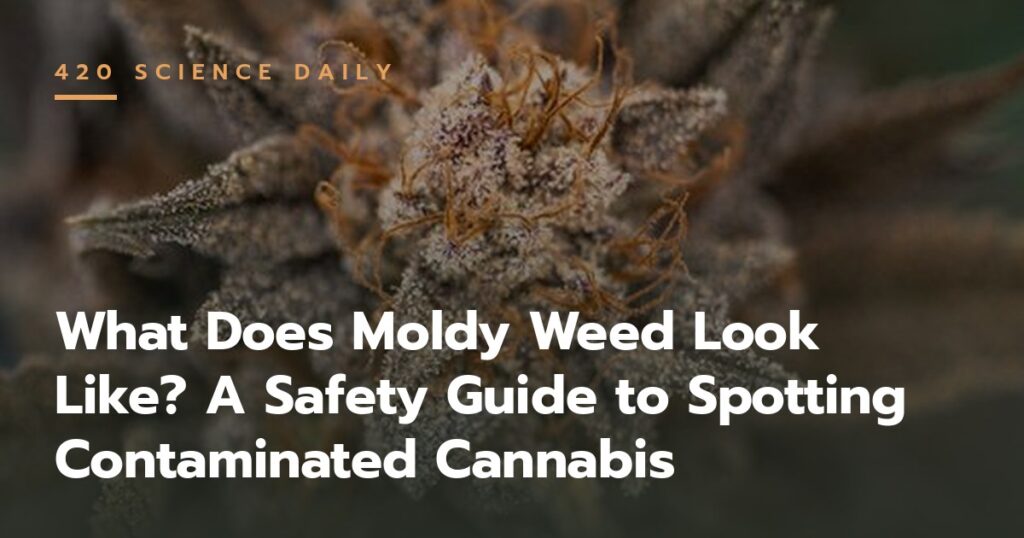
What Does Moldy Weed Look Like? A Safety Guide to Spotting Contaminated Cannabis
Short answer: Moldy weed looks fuzzy, powdery, or web-like — dull white, gray, or brownish patches that sit on or inside the bud — while healthy trichomes look like sparkly, sticky crystals. If it smells musty, mildewy, or like ammonia, and the texture feels wrong, don’t smoke it.
Finding out your weed might be moldy is an awful moment. You paid good money for it, it might have been a gift, or maybe it’s a jar you stashed away months ago — and now something looks off. The good news: with a few minutes and a magnifier, you can tell pretty reliably whether you’re looking at mold or just really frosty bud. This guide walks through exactly what mold looks like on cannabis, how it differs from trichomes, the two most common types (powdery mildew and bud rot), what it smells like, whether you can salvage it, and how to store weed so this never happens in the first place.
How Do You Tell Mold Apart from Trichomes?
This is the single most common point of confusion, especially for newer cannabis users. Trichomes — the tiny resin glands where THC, CBD, and terpenes live — can look like a fuzzy white coating at first glance. But once you know what to look for, they’re easy to tell apart.
Healthy trichomes sparkle. They catch the light like tiny diamonds or sugar crystals, and under a jeweler’s loupe (30x–60x magnification, cheap and worth owning), each one looks like a little mushroom or lollipop: a stalk with a round, resin-filled head. They feel sticky when you touch the bud. They grow in an even, uniform coating across the flowers and sugar leaves.
Mold, by contrast, looks dull and dirty. It grows in irregular patches, wispy webs, or fuzzy clumps — not an even coating. It doesn’t sparkle; it sits on the bud like dust, lint, or cotton. Colors tend toward gray, off-white, brownish, or yellowish, and the texture is fuzzy or slimy rather than sticky and crystalline.
| Sign | Healthy Trichomes | Mold |
|---|---|---|
| Appearance | Sparkly, crystalline, like sugar or diamonds | Dull, fuzzy, webby, or powdery patches |
| Distribution | Even coating over buds and sugar leaves | Irregular patches, spots, or clumps |
| Under a loupe | Mushroom-shaped glands with round heads | Thread-like filaments, webbing, or amorphous fuzz |
| Touch | Sticky and resinous | Fuzzy, dusty, powdery, or slimy |
| Color | Clear, milky white, or amber | Gray, off-white, brown, yellowish |
| Smell | Pungent, terpy — pine, citrus, skunk, fuel | Musty, mildewy, damp-basement, or ammonia-like |
The loupe test is the tiebreaker. If you’re squinting at your bud and can’t decide, a magnifier settles it fast: mushrooms equal trichomes, webs and fuzz equal mold. There’s also a simple wipe test for the powdery kind: gently touch a white patch with a clean gloved finger. Powdery mildew dusts off like flour, leaving green tissue underneath. Trichomes don’t wipe away like powder — they’re sticky and attached to the plant.
What Does Powdery Mildew Look Like on Buds?
Powdery mildew is the easiest mold to spot, and it usually starts on the leaves before reaching the flowers. It looks exactly like its name suggests: a light dusting of flour or powdered sugar on the leaf surfaces, often in circular patches. Unlike trichomes, it’s matte and dusty — it doesn’t glitter.
Early signs include small white spots on the upper sides of fan leaves, sometimes with yellowing or a dull look in the surrounding tissue. As it spreads, it coats stems, sugar leaves, and eventually the buds themselves with a chalky white film. On dense colas it can look like a gray-white fuzz settling into the crevices between calyxes.
Powdery mildew thrives in warm, humid conditions with poor airflow — which is why it shows up both in indoor grows with stagnant air and in buds that were stored while still too damp. It can also hitchhike on plants grown under stress, since a stressed plant is more vulnerable; keeping an eye out for early plant stress signals like tacoing leaves can help you catch environmental problems before they turn into mold problems.
If you spot powdery mildew on a living plant, growers generally remove the worst-affected material and improve airflow, temperature, and humidity right away. But once it’s on harvested, dried bud you’re planning to consume? That bud is a loss. Don’t try to wash, wipe, or bake it off — the visible powder is only part of the colony.
What Does Bud Rot Look Like?
Bud rot (caused by the fungus Botrytis) is the sneakier of the two, and arguably the worse find. Where powdery mildew sits on the surface, bud rot usually starts inside dense buds, where trapped moisture gives it a dark, still place to grow. By the time you see it on the outside, it may have been developing for days.
Here’s what to look for:
- Discolored, lifeless patches — brown, gray, or dark sections within otherwise healthy-looking buds. Gently pull a dense bud apart and check the core: healthy flower is green and springy; rot turns it tan, brown, or gray and makes it mushy, crumbly, or oddly dry.
- A dying sugar leaf — a single small leaf sticking out of a cola that suddenly yellows or browns while the rest of the plant looks fine, and pulls out far too easily. This is a classic early warning sign growers watch for.
- Fuzzy gray growth — in advanced cases you’ll see actual gray or whitish fuzzy fungal mass, sometimes with a slimy sheen, tucked inside the bud.
- The smell — bud rot has a distinctive musty, mildewy, sometimes ammonia-like scent that’s impossible to mistake for terpenes once you’ve smelled it.
Bud rot is most common in big, dense colas — the kind that look most impressive are also the most at risk, because moisture gets trapped deep inside them. If you find it, the entire bud needs to go, and you should inspect every other bud from the same batch. Because rot spreads invisibly, quarantine anything suspect rather than just snipping the brown part.
What Does Moldy Weed Smell Like?
Your nose is one of the best mold detectors you have, and sometimes it catches what your eyes miss. Fresh cannabis smells pungent and terpy — citrus, pine, skunk, fuel, earth, sweetness, depending on the strain. Moldy cannabis smells like none of those things.
Watch for these smell signatures:
- Musty or damp-basement smell — the classic mold giveaway. Think wet cardboard, an old attic, or a locker room that never dries out.
- Hay-like or grassy smell — in freshly dried bud, a strong grassy/hay aroma usually means it was dried or cured too fast rather than molded, but it can overlap with early mold development and is worth investigating.
- Ammonia or sour rot smell — a sharp, chemical, almost urine-like note. This points toward bud rot or bacterial activity and is a hard no.
- Flavor of harshness — if you already took a puff before checking (it happens), moldy weed tastes bitter, acrid, and harsh, completely different from the smooth flavor of healthy flower. If it tastes wrong, stop.
One more note: a smell change doesn’t necessarily mean mold. Overdried or old bud loses its terpenes and can smell faint or bland — that’s a quality problem, not a safety problem. The musty, ammonia, and rotten notes are the ones that spell danger.
Can You Smoke Moldy Weed?
No — you can’t just “smoke around it,” pick the moldy parts out, or bake the bud to kill the mold and make it safe. This is the part of the article nobody wants to hear, so here’s the straight answer.
The fuzzy patch you can see is only the fruiting body of the fungus. The rest of it — the mycelium — is a network of microscopic filaments running through the bud, and you can’t see it. Cutting off the visible mold doesn’t remove the contamination. Heating the bud doesn’t reliably make it safe either: research has shown that Aspergillus spores can survive passage through a burning cannabis cigarette, and many molds produce mycotoxins — toxic compounds that aren’t destroyed by heat.
What about vaping instead of smoking? It doesn’t help either. A vaporizer still carries spores and toxins into your lungs, just with less combustion — and vaping weed produces its own noticeable smell, so there’s no stealth advantage that justifies the health risk. The only safe move with moldy cannabis is to dispose of it.
Now for the honest, non-alarmist context: a healthy adult who accidentally takes a hit or two of moldy weed will most likely experience, at worst, coughing, throat irritation, or an allergic-type reaction — the same kind of symptoms you’d get from inhaling mold spores from a damp wall. The serious risks concentrate in people with weakened immune systems: chemotherapy patients, organ transplant recipients, people with HIV/AIDS, those on immunosuppressive medications, and people with chronic lung conditions like asthma. For them, inhaling Aspergillus and similar molds can cause invasive lung infections like aspergillosis, which are genuinely dangerous — health professionals generally advise these patients to never consume cannabis that shows any sign of mold contamination, and to buy from regulated, lab-tested sources when possible.
So: if your bud is moldy, throw it out. Seal it in a bag first so you don’t scatter spores around your storage area, and check any bud that was stored alongside it.
How Do You Store Weed to Prevent Mold?
Almost every case of moldy weed traces back to storage, not bad luck. Cannabis flower still contains some moisture after curing, and mold spores are everywhere in the air — give them dampness plus still air and time, and they’ll colonize your jar. The rules are simple:
- Use airtight glass jars. Mason jars are the gold standard for a reason: glass doesn’t off-gas, and a tight seal keeps fresh humid air from cycling in. Store buds loosely — don’t pack them in tight, and fill jars only about two-thirds full so air can circulate.
- Keep it cool and dark. Light and heat degrade THC and terpenes, and warmth speeds mold growth. A cupboard or drawer at room temperature works; a refrigerator or freezer introduces condensation risk every time you open the container, so skip those.
- Control the humidity. Many growers and dispensaries aim for roughly 55–65% relative humidity inside the storage container. Two-way humidity control packs (designed for cannabis storage) make this automatic: they release or absorb moisture to hold the level steady. They’re cheap, last months, and are the single easiest upgrade to your storage setup.
- Don’t store long-term in plastic bags. Ziplocks and sandwich bags build up static (which strips trichomes), don’t seal well, and trap condensation against the bud. Fine for a day trip; bad for a month.
- Inspect your stash regularly. Once a month, give your jars a visual check and a sniff. Catching a humidity problem early — a jar that’s sweating, buds that feel damp or spongy — means airing it out before mold ever gets started.
If you’re buying from a dispensary, you can also reduce your risk at the source: buy from reputable, lab-tested suppliers, check the harvest or packaged-on date, and avoid bud that looks dull, feels excessively moist, or smells off before you even hand over money. Medical patients with compromised immunity should treat lab testing as a requirement, not a bonus.
Frequently Asked Questions
Can you smoke moldy weed?
No. Smoking moldy weed is not safe, and there’s no reliable way to salvage contaminated cannabis — picking off the moldy parts doesn’t remove the invisible mycelium running through the bud, and heating doesn’t reliably destroy spores or the mycotoxins some molds produce. Discard the affected bud in a sealed bag.
What happens if you smoke moldy weed?
For a healthy person, a small accidental exposure typically causes coughing, throat or chest irritation, or an allergic-type reaction. The serious risks — invasive lung infections like aspergillosis — fall mostly on people with weakened immune systems or chronic lung conditions. If you’re immunocompromised and consumed moldy cannabis, talk to your doctor, especially if you develop a persistent cough, fever, or breathing difficulty.
Can you cut the mold off and use the rest?
No. The visible mold is just the fruiting body; microscopic fungal threads (mycelium) extend throughout the surrounding bud, including parts that look perfectly fine. Health professionals and experienced growers alike advise disposing of the entire affected batch rather than trying to trim around it.
How can you tell if weed has mold vs trichomes?
Trichomes sparkle like crystals, are sticky to the touch, and look like tiny mushrooms under a magnifier. Mold looks dull, fuzzy, webby, or powdery, grows in irregular patches, and often smells musty or mildewy. When in doubt, check with a jeweler’s loupe (30x–60x): mushroom-shaped glands are trichomes; threads and fuzz are mold.
Does vaping kill mold on weed?
No — vaporizing moldy cannabis is not safe. A vaporizer still delivers mold spores and mycotoxins into your lungs; lower heat doesn’t reliably destroy them. Neither smoking, vaping, baking, nor making edibles from moldy weed makes it safe to consume.
Last updated: October 2026