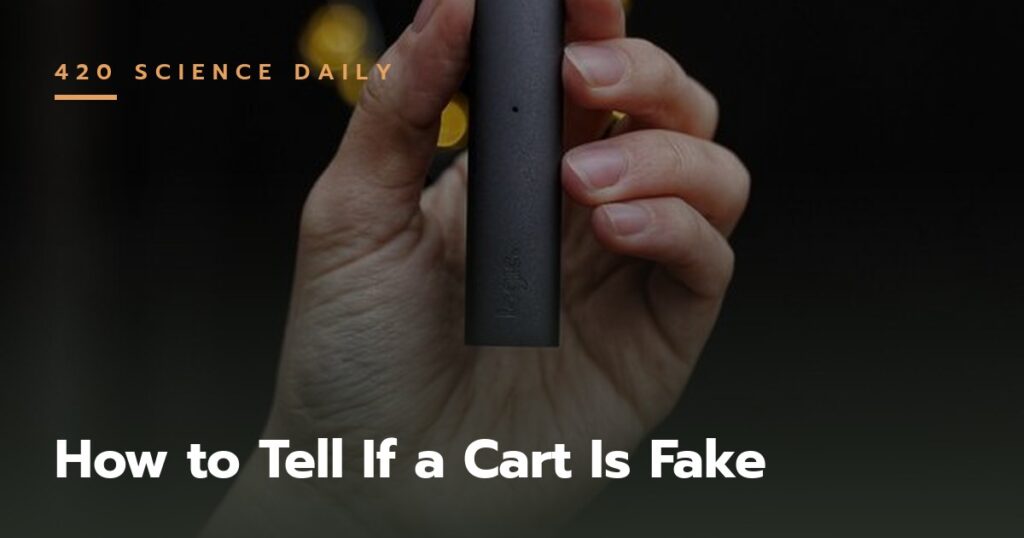
A vape cart is a small thing to trust with your lungs, and the market makes that trust hard to earn. In states and countries with legal cannabis, licensed cartridges are tested, labelled and traceable. Outside that system, the same brand names appear on packaging that was never near a licensed facility — filled with oil of unknown origin, cut with unknown additives, and sold at prices no legal shop could match. The packaging can look convincing. The oil can look convincing. So how do you actually tell?
That limit matters more than any single tip in this guide. A counterfeiter can copy a box, print a QR code and fill a cartridge with oil that looks about right. The checks below are about stacking evidence: one red flag is a warning, three is a verdict. If you want the background on contaminated cannabis more generally — including the signs that flower has been tampered with — our guide to how to know if your weed is laced covers that side of the problem.
What is a fake cart, exactly?
A fake cart is a counterfeit: a cartridge and packaging made to look like a real, usually popular, brand, but produced outside that brand’s licensed supply chain. The most common version is a well-known brand name — the sort of name you would recognise from a dispensary shelf — sold by an unlicensed seller, at a street price, in packaging that was printed to imitate the real thing. Empty cartridges and printed boxes for popular brands are sold openly online, so anyone with oil of any quality can assemble a convincing-looking product.
That is different from a laced product, though the two overlap. “Laced” means something extra has been added to the cannabis itself — another drug, a synthetic cannabinoid, or a cutting agent. A fake cart may well contain laced oil, but the word “fake” here describes the product’s origin, not its contents: it is not what the label says it is, from a maker you cannot trace, with no lab test behind it.
There is also a grey area worth naming. Some carts are not copies of any brand at all — unbranded, no licence number, no lab results, sold loose or in plain packaging. These are not counterfeits in the strict sense, because there is no genuine original to copy. But for your purposes the distinction hardly matters: an untested, untraceable cart carries the same risks as a fake one. The checks in this guide apply to both.
How can you tell if a cart is fake before you buy it?
The strongest checks happen before the cart is ever in your hand, and the first of them is the seller. Licensed dispensaries buy from licensed manufacturers, and every product on their shelves has passed through a state testing regime. A cart bought from a licensed shop is not guaranteed perfect — recalls happen — but it is traceable, tested and accountable in a way a street cart never is. If you bought your cart from a social media seller, a pop-up shop, a market stall or a friend of a friend, treat every other check below as damage control, not reassurance.
Price is the next giveaway. Licensed carts carry the costs of cultivation, testing, tax and compliance, so they sell within a fairly narrow price band in any given area. If one seller is offering the same brand at half the price of every dispensary nearby, that gap has to come from somewhere — and it usually comes from skipping the testing, the tax and the licensed oil. A bargain cart is not a find; it is a flag.
Then read the box properly, before you open it. A legitimate, licensed cartridge should carry:
- A licence number for the manufacturer (and usually the distributor), printed on the packaging. You can check it against your state regulator’s licence database — California, for example, tells consumers to look for the licence on every legal product and provides a way to verify it.
- A batch or lot number and a manufacture or packaging date. Real producers track every batch; counterfeiters often print the same batch number on thousands of boxes, or leave the date off entirely.
- A QR code. On a genuine product this links to the batch’s certificate of analysis (COA) — the lab report for that specific batch. Scan it in the shop if you can. It should take you to a named, accredited third-party lab’s report, not to a brand homepage, a dead link or a generic PDF.
- Full ingredient and potency information, including cannabinoid content. Vague wording, missing percentages or no mention of what is actually in the oil are all signs the maker had nothing to disclose — or nothing good to disclose.
- Child-resistant packaging. Licensed markets require it. A cart in a plain box with no seal, no tamper-evident strip and no child-resistant mechanism was not made for a regulated shelf.
Finally, look at the print quality. Licensed brands invest in packaging; counterfeit operations invest in looking like they did, and the gap usually shows. Typos, misspelt brand names, blurry logos, colours that are slightly off, text that sits crooked, a hologram sticker that peels or smudges under your thumb — any of these is a reason to stop. Also watch for branding that a licensed product would never carry: cartoon characters, cereal or sweet brands, and bright colours designed to appeal to children are banned in regulated markets such as New York’s, so their presence on the box is close to a confession.
What does the oil inside tell you?
Once the box passes — or if there is no box at all — the oil itself is your next source of evidence. Hold the cartridge up to the light and look carefully before you use it.
Colour first. Good cannabis oil is usually clear and light gold, straw, amber or, in some cases, almost clear. The exact shade varies by strain, extraction method and age, and it darkens a little over time, so colour alone never proves anything. But a brand-new cart should never hold oil that is dark brown, black, green-tinted or cloudy, and it should never contain visible particles, separation layers or anything floating in it. Those are signs of poor production, contamination or very old oil — and a cart like that should not be used whether it is fake or not.
Then the bubble test, the oldest trick in this guide and still a useful one. Turn the cartridge upside down and watch the air bubble. In thick, properly made oil the bubble moves slowly, in one piece, taking its time from one end to the other. If the bubble rushes through, the oil is thin — possibly cut with a thinning agent or simply low quality. If there is no bubble at all, or the oil barely moves, it may be suspiciously thick, which can also mean it has been cut with something heavy. The test is rough, not precise: temperature changes viscosity, so a cart left in a hot car will look thinner than the same cart at room temperature. Run it at room temperature, and treat the result as one piece of evidence among several.
What the bubble test cannot do is detect the most dangerous additive of all. Vitamin E acetate — the cutting agent linked to the 2019 outbreak of vaping-related lung injury — looks and behaves like pure cannabis oil. It is thick, clear and golden, and it passes every visual check in this section. That is the central frustration of spotting a fake cart by eye: the thing most worth finding is invisible. The only real protection against it is the lab report, which is why the QR code and COA matter more than the colour of the oil.
How do you check the hardware?
Real cartridges are built to a standard, and cheap counterfeits usually are not. Pick the cart up and inspect it like the piece of hardware it is.
- Materials. Genuine cartridges are typically glass and stainless steel, or high-grade plastic, with a solid feel and some weight to them. Suspiciously light, flimsy plastic that flexes under your fingers suggests a factory cutting corners.
- Threading. The 510 thread at the base should screw onto a battery smoothly, without wobbling, catching or cross-threading. Rough, uneven threading that scratches the battery or needs force is a common counterfeit tell.
- Mouthpiece and seals. The mouthpiece should sit flush and secure, usually ceramic or metal rather than cheap plastic, with no chemical smell before you use it. Air holes should be even in size and placement, not lopsided or clogged. Leaking oil around the base or mouthpiece is a sign of poor assembly — and a reason not to inhale from it.
- Branding on the cart itself. Many licensed brands etch or print their name on the cartridge, not just the box. A blank cart in a branded box is a mismatch worth noticing.
There is one more hardware check that only happens after you use the cart, and it is the one to take most seriously: taste and feel. A cart from a licensed producer should taste like cannabis — the strain’s own flavour, clean and consistent. A metallic taste, a harsh chemical burn, a plasticky aftertaste, or a smell that seems wrong are all signals to stop immediately. Do not push through a bad-tasting cart to see if it gets better. If it tastes wrong, put it down.
The table below pulls all nine checks together at a glance, so you can run through them in order the next time a cart is in your hand.
| Check | Real (licensed) cart | Fake cart |
|---|---|---|
| Where it was sold | Licensed dispensary | Street, social media, unlicensed shop |
| Price | In line with local dispensary prices | Far below the local norm |
| Licence number | Printed on the box, verifiable with the regulator | Missing, or copied from a real brand |
| QR code / lab report | Scans to a batch-specific COA from a named third-party lab | Missing, dead link, or a generic page |
| Batch and date | Batch/lot number and manufacture date printed | Missing, or the same number on every box |
| Packaging | Sharp print, correct spelling, child-resistant, tamper-evident | Typos, blurry logos, cartoon branding, no seal |
| Oil colour | Clear, light gold to amber | Dark brown, black, green, cloudy, or particles visible |
| Oil thickness | Thick; bubble moves slowly when tilted | Watery (bubble rushes) or oddly thick |
| Hardware | Glass and metal, smooth threading, branded mouthpiece | Flimsy plastic, rough threads, leaks, chemical smell |
What are the risks of using a fake cart?
The reason this matters is not the money. It is what an untested cart can put into your lungs. In 2019, an outbreak of severe lung injury linked to vaping — called EVALI — put thousands of people in hospital across the United States. The US Centers for Disease Control and Prevention (CDC) reported 2,807 hospitalised cases and 68 deaths by 18 February 2020. When researchers analysed lung fluid from EVALI patients, they found vitamin E acetate — a thickening agent used to dilute THC oil — in the samples, and the CDC identified it as strongly linked to the outbreak. Vitamin E acetate is safe enough in skin creams and supplements; heated and inhaled, it is a different story.
That outbreak is the clearest evidence of what is at stake, but it is not the only risk. Untested oil can carry pesticide residues, residual solvents from extraction, and heavy metals leached from cheap hardware — lead and cadmium among them — none of which you can see, smell or taste in advance. The symptoms reported with contaminated carts include shortness of breath, chest pain, coughing, nausea and vomiting, and fatigue. Anyone who develops breathing difficulty after vaping should seek medical care promptly and tell the clinician exactly what they used — and if you want a sense of how seriously cannabis use can interact with the body more broadly, our guide to can you smoke too much weed covers the symptoms and risks of overconsumption.
None of this means every unlicensed cart will harm you. Plenty of people have used them without obvious problems, and the risk on any single cart is impossible to quantify — which is precisely the point. With a licensed cart, a lab has measured what is inside and a regulator can trace it back to its maker. With a fake one, you are guessing, and the guess is about your lungs.
What should you do if you already bought a fake cart?
First, do not use it — and do not pass it on to someone else. A cart you would not inhale from is not a gift. If you bought it from a shop, take it back with the receipt and say why: reputable retailers will want to know a counterfeit reached their shelf, and in a licensed market they have a duty to act on it. If you bought it from an unlicensed seller, report the seller to your state cannabis regulator or consumer protection body if you can; enforcement depends on people reporting what they find.
If you have already used the cart and feel unwell — especially breathing trouble, chest pain or persistent coughing — get medical attention and be honest about what you vaped. Doctors cannot help with information they do not have, and there is no legal penalty for telling a clinician the truth about cannabis use. Keep the cart and its packaging if you can: batch numbers and branding help investigators trace a bad product, and a photo of the box is better than nothing if you have already thrown it away.
Going forward, the simplest rule is also the most reliable one: buy from licensed dispensaries, check the licence and the lab report every time, and treat any cart that fails those two checks as a fake — whatever the box says. And if you vape regularly, it is worth knowing how much of that vapour other people can actually smell; our guide to does vaping weed smell looks at what the research and real-world reports say.
Frequently asked questions
How to tell if a cart is fake?
Check the seller first — only a licensed dispensary can be verified. Then look for a licence number, batch number and manufacture date on the box, scan the QR code to confirm it opens a real certificate of analysis from a named third-party lab, and inspect the oil (clear, light gold to amber, thick enough that the bubble moves slowly) and the hardware (glass and metal, smooth threading, no leaks). A price far below the local norm, typos or cartoon branding are strong warning signs.
Can you tell if a cart is fake by the colour of the oil?
Only partly. Genuine cannabis oil is usually clear and light gold to amber; a brand-new cart with dark brown, black, green or cloudy oil, or visible particles, should not be used. But colour alone cannot prove a cart is real — the most dangerous additive, vitamin E acetate, looks just like pure oil. Colour is a useful red flag, not a verdict.
Do fake carts have QR codes?
Many do, because a QR code is easy to print. What matters is where it leads. A genuine QR code opens a batch-specific certificate of analysis from a named, accredited lab, with a test date and results that match the product in your hand. A fake one leads nowhere, to a brand homepage, or to a generic document that does not match the batch. Scan it — do not just check that it exists.
Are fake carts dangerous?
They can be. The 2019 EVALI outbreak, which the CDC linked to vitamin E acetate in illicit THC cartridges, caused 2,807 hospitalisations and 68 deaths in the United States. Untested carts can also contain pesticide residues, residual solvents and heavy metals from cheap hardware. The risk from any single cart cannot be measured in advance, which is why the safest course is to use only tested, licensed products.
What should I do with a fake cart?
Do not use it and do not give it away. Return it to the shop if you bought it from one, report the seller to your state cannabis regulator if you can, and keep the cart and packaging in case investigators need the batch details. If you have already used it and have breathing difficulty, chest pain or a persistent cough, seek medical care and tell the clinician what you vaped.
Sources
- Centers for Disease Control and Prevention (2020). Outbreak of lung injury associated with the use of e-cigarette, or vaping, products. https://archive.cdc.gov/www_cdc_gov/tobacco/basic_information/e-cigarettes/severe-lung-disease.html — CDC outbreak data (archived page, updated 25 February 2020): 2,807 hospitalised EVALI cases and 68 deaths in the US as of 18 February 2020, and vitamin E acetate strongly linked to the outbreak.
- Blount, B. C., Karwowski, M. P., Shields, P. G., et al. (2020). Vitamin E acetate in bronchoalveolar-lavage fluid associated with EVALI. New England Journal of Medicine, 382(8), 697–705. https://www.nejm.org/doi/full/10.1056/NEJMoa1916433 — vitamin E acetate found in lung fluid of EVALI patients, the key evidence behind the CDC’s finding.
- California Department of Cannabis Control (n.d.). Search for a licensed business. https://www.cannabis.ca.gov/resources/search-for-licensed-business/ — the regulator’s licence search tool: consumers can verify whether a cannabis business is licensed before buying.
Educational content only — not medical advice. Cannabis laws vary by region.
Last updated: 8 November 2026