The short answer
When cannabis is ready to harvest, most of the trichomes on the buds look cloudy or milky white, like frosted glass, with roughly 10–20% turned amber or golden. Clear, glass-like trichomes mean the plant is not ready yet. Mostly amber trichomes mean you have waited past peak potency and the effect will feel heavier and more sedative. Check the trichomes on the buds themselves (calyxes), not the sugar leaves, using a 30x–60x jeweller’s loupe under white light.
What are trichomes, and why do they decide harvest time?
Trichomes are the tiny, mushroom-shaped glands that coat cannabis flowers and give good bud its frosty, sparkling appearance. They are the plant’s resin factories: cannabinoids such as THC and CBD, along with the terpenes that shape aroma and flavour, are produced and stored inside them. Research from the University of British Columbia confirmed that the largest, stalked glandular trichomes are the richest source of THC- and CBD-forming metabolites and fragrance-giving terpenes, which is why the frostiest flowers tend to be the most potent.
That is also why trichomes beat every other harvest signal. Pistil colour, breeder timelines and calendar dates are all rough guides at best. Pistils can darken from heat, handling or stress, and a strain’s stated flowering time is an estimate under ideal conditions. Trichome colour, by contrast, shows you what is actually happening inside the resin right now. A study tracking glandular trichome development through flowering found three distinct phases — pre-secretory, secretory and post-secretory — with cannabinoid and terpene accumulation peaking during the secretory phase and metabolic activity falling off afterwards. In plain terms: the resin has a peak, and the trichomes show you when you are standing on it.
What do trichomes look like at each stage?
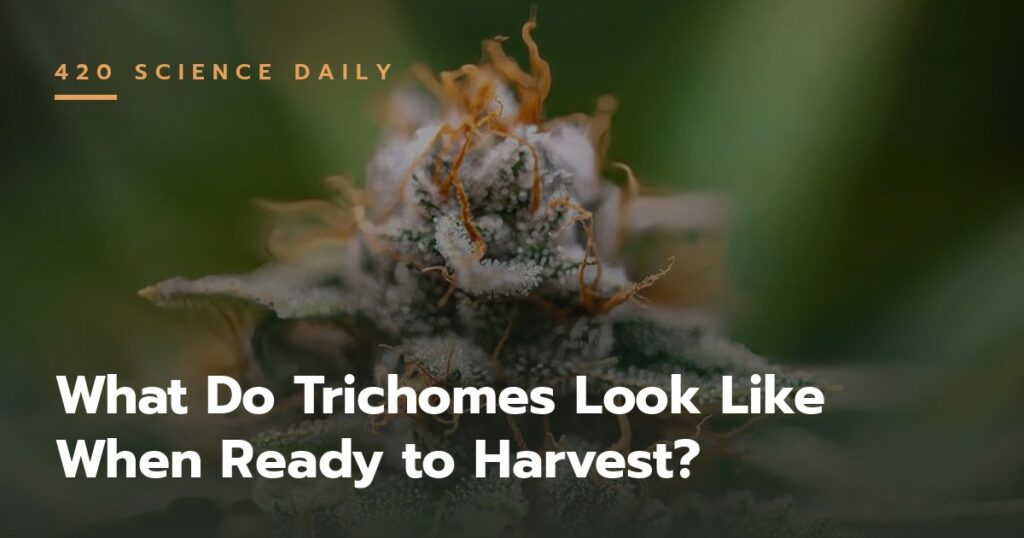
Under magnification, a mature trichome looks like a tiny mushroom: a thin stalk topped with a round, bulbous head. It is the head that changes colour as the plant matures, and that colour is your harvest clock. The progression runs in one direction only — clear, then cloudy, then amber — and you will usually see all three stages on a single bud at once. What matters is the overall mix, not any single gland.
Clear trichomes look transparent and glassy, like tiny drops of water. The resin is still being built, cannabinoid production is incomplete, and the terpene profile has not fully developed. Buds harvested at this stage tend to feel weaker and sometimes produce a racy, unsettled effect, with a greener, less developed flavour. If most heads are still clear, the plant simply is not finished.
Cloudy (milky) trichomes look opaque and frosted white, with no transparency left — think frosted glass rather than clear glass. This is the stage most growers aim for. Cannabinoid production has peaked, and the terpene profile is at its loudest. The effect at this stage tends to be brighter and more energetic, which is why growers chasing an uplifting, daytime finish cut when the field is mostly cloudy with very little amber.
Amber trichomes range from pale gold to deep honey-brown. The colour change signals that THC is beginning to oxidise into CBN, a cannabinoid associated with heavier, more sedative effects. Amber does not mean stronger — it means the resin is ageing. A small amber fraction adds body and depth to the effect; a mostly amber field means potency has already started to decline.
Trichome harvest chart: clear vs cloudy vs amber
| Trichome stage | What it looks like | What it means | Typical effect |
|---|---|---|---|
| Clear | Transparent, glassy heads | Not ready — resin still developing | Weaker, underdeveloped, sometimes racy |
| Cloudy / milky | Opaque, frosted-white heads | Peak potency window | Bright, energetic, full flavour |
| Amber | Golden to honey-brown heads | THC oxidising to CBN — past peak | Heavier, more sedative, body-focused |
Most home growers land their harvest somewhere in this range:
| Target mix | Best for |
|---|---|
| Mostly cloudy, 0–10% amber | Maximum potency, uplifting and energetic effects |
| Mostly cloudy, 10–20% amber | The classic all-round harvest — potent with a little body |
| Mostly cloudy, 20–30% amber | Relaxing, heavier finish; popular for evening use |
| Mostly amber (50%+) | Very sedative, but potency has declined — usually cut too late |
These ratios are grower conventions, not laboratory thresholds — individual trichomes on the same flower vary, and genetics shift the picture. Treat the percentages as a guide to the overall field you see through the loupe, not a number you need to count precisely.
How do you check trichomes properly?
The tool matters. Naked eyes cannot resolve trichome heads, and a phone camera zoomed in usually cannot either. A 30x–60x jeweller’s loupe costs very little and is the standard tool for this job; a USB microscope that connects to a phone or laptop gives an even clearer view and lets you photograph the field for comparison over days.
Check under white light, not under your grow lights. The pink or purple cast of LED panels distorts colour badly, and amber is easy to misread under coloured light. Either look at the plant during a lights-off period with a white torch, or snip a tiny sample and examine it under normal room light. Do not judge colour from a photograph taken under grow lights.
Where you look matters even more than what you look through. Follow this sampling routine:
- Look at the buds, not the sugar leaves. Trichomes on sugar leaves mature roughly a week earlier than those on the buds. Judging by the leaves is the single most common cause of harvesting too early.
- Check the calyxes — the small pod-like structures that make up the bud itself — on several different colas, including lower and interior buds, not just the top cola.
- Sample 3–5 spots per plant and take the average. One cola can run ahead of the rest, especially the one closest to the light.
- Check daily once you see the first cloudy heads. The window from mostly cloudy to heavily amber can pass in about a week, and the shift accelerates late in flowering.
- Hold the plant still. Trichome heads are fragile and snap off with handling. Support the branch, rest the loupe against it, and avoid brushing the buds while you look.
If your top colas are ready while lower buds are still clear, you do not have to cut everything at once. Many growers harvest the ripe top buds first and leave the lower buds for another week under improved light — a staggered harvest that gets the best from both.
What else should you check alongside trichomes?
Trichomes are the deciding factor, but two supporting signals help confirm you are reading them right. First, the pistils: as buds mature, most of the white hairs darken and curl inward. When roughly 70–90% of pistils have darkened and receded, the plant is usually in the harvest window — but pistils react to heat and handling too, so never use them alone. Second, the buds themselves: mature flowers feel dense and swollen, with calyxes visibly plumped, and the plant’s overall growth slows as energy shifts from building to ripening.
One caution from late flowering: if you have been training or maintaining the plant through flower, stop heavy work well before harvest. Late stress does not help resin and can cost you the finish you have been waiting for. Our guide to how to prune a weed plant explains why pruning belongs in veg and early flower, not the final weeks. And if your leaves are showing stress signs at the same time — folding upward, for example — check our guide to cannabis leaves tacoing before assuming the plant is simply ripening; light or heat stress in late flower can damage the very trichomes you are trying to mature.
What happens if you harvest too early or too late?
Cutting early is the more expensive mistake. Buds harvested with mostly clear trichomes have not finished producing cannabinoids or terpenes, so the result is weaker, less flavoursome and often described as racy or incomplete. You also lose yield: buds put on significant weight in the final one to two weeks as calyxes swell and resin builds, so an early cut costs both potency and mass. There is no way to finish ripening after the cut.
Cutting late costs less dramatically but still costs. As more trichomes turn amber, THC continues converting to CBN, the brightest terpenes fade, and the effect shifts from potent to heavy and sleepy. A very late harvest can also bring practical risks — dense, overripe buds left standing are more vulnerable to mould and bud rot, especially in humid conditions. The aim is not “as amber as possible” but the mix that matches the effect you want, caught before decline sets in.
Timing also interacts with plant type. Photoperiod strains generally finish 8–12 weeks after the switch to flowering, while autoflowers usually run 9–11 weeks from seed, but both ranges vary widely by genetics — which is why the trichomes, not the calendar, make the call. If you are still deciding what to grow next, our comparison of autoflower vs photoperiod yield covers how the fixed autoflower clock changes harvest decisions, since an autoflower gives you no extra veg time to recover from mistakes.
Frequently asked questions
What do trichomes look like when ready to harvest?
Mostly cloudy or milky white heads with about 10–20% turned amber, checked on the buds (calyxes) under 30x–60x magnification and white light. Clear heads mean not ready; mostly amber heads mean past peak potency.
Should trichomes be cloudy or amber at harvest?
Both, in proportion. Mostly cloudy gives peak THC and a brighter effect; a small amber fraction (10–20%) adds body and depth. Harvesting at 100% cloudy with no amber suits growers chasing maximum uplift, while 20–30% amber suits a more relaxing finish. There is no single correct ratio — it depends on the effect you want.
Can you harvest with all cloudy trichomes and no amber?
Yes. An all-cloudy harvest captures peak potency before any THC has converted to CBN, and many growers prefer it for energetic, daytime flower. The trade-off is a slightly less rounded effect and, on some strains, a sharper edge. It is a legitimate choice, not a mistake.
Do amber trichomes mean the weed is stronger?
No — the opposite. Amber means THC is oxidising into CBN, so overall psychoactive potency is declining while the effect becomes heavier and more sedative. Amber is desirable in small amounts for a relaxing finish, but a mostly amber crop is less potent than the same crop cut at mostly cloudy.
What magnification do you need to see trichomes?
A 30x–60x jeweller’s loupe is the standard minimum and is enough to judge clear vs cloudy vs amber. A USB microscope (60x–200x) gives a clearer view and lets you photograph the trichomes to track changes day by day. Phone camera zoom alone is usually not enough for a reliable call.
Sources / further reading
- University of British Columbia — “The frostier the flower, the more potent the cannabis” (research summary; Livingstone, Quilichini & Samuels, The Plant Journal): https://science.ubc.ca/news/frostier-flower-more-potent-cannabis-ubc-study
- Characterisation of Cannabis glandular trichome development reveals distinct features of cannabinoid biosynthesis, Plant Cell Reports (2024): https://link.springer.com/article/10.1007/s00299-024-03410-9
- Delineating genetic regulation of cannabinoid biosynthesis during female flower development in Cannabis sativa (2022): https://pmc.ncbi.nlm.nih.gov/articles/PMC9219008/
Educational content only — not medical advice. Cannabis laws vary by region.