
The Short Answer
Deformed leaves on a weed seedling are usually caused by overwatering, light that is too strong or too close, cold or hot temperatures, or feeding too early — not by disease. In most cases the seedling recovers on its own once the cause is fixed, and the next set of true leaves comes in normally. Only start worrying if the deformity spreads to new growth, the stem pinches and collapses at the soil line, or the plant stops growing altogether for more than a few days.
There is nothing quite like the sinking feeling of checking on a seedling you coaxed out of its shell, only to find its first true leaves twisted, curled, crinkled or bent out of shape. After days of watching for that first sprout, deformed leaves feel like a disaster. The good news is that, at the seedling stage, they very rarely are. A cannabis seedling is a tough little plant, and most early leaf deformities are the plant’s way of telling you something about its environment — too much water, too much light, the wrong temperature, or a feed it did not need yet.
This guide walks through what healthy seedling leaves should look like, the most common causes of deformed leaves (and the rare ones worth knowing about), how to diagnose the problem from the shape of the leaves, and exactly what to change to fix it. It also covers when to stop nursing a seedling and start a fresh seed instead.
What Does a Healthy Weed Seedling Look Like?
Before diagnosing a problem, it helps to know what normal looks like — because seedlings do a few things that look alarming but are entirely fine.
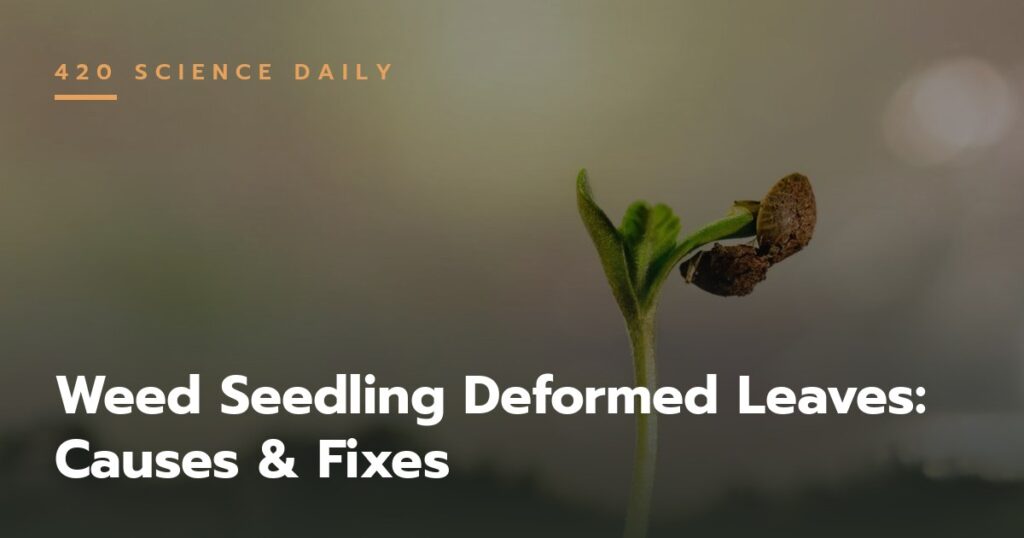
A cannabis seed emerges with two small, round, smooth leaves called cotyledons. These are not true leaves: they are the seed’s packed lunch, feeding the seedling until it can photosynthesise for itself. Within a few days, the first pair of true leaves appears — single-fingered, serrated, and recognisably cannabis-shaped. The next sets add fingers: three, then five, then seven.
Here is what is normal and not a cause for concern:
- Yellowing cotyledons. As the true leaves take over, the cotyledons yellow and drop off. This is the plant using up its stored food, not a deficiency.
- A slightly uneven first pair of true leaves. The first true leaves are often a little lopsided or wavy. Seedlings are not precision instruments, and small asymmetries usually vanish by the second or third node.
- A seed shell stuck on a leaf (“helmet head”). Sometimes the shell does not fall away cleanly and pinches a leaf as it opens. Mist it lightly and, if it does not come off on its own within a day, ease it off gently with clean tweezers. Do not yank it — a torn leaf is worse than a bent one.
- A short pause after sprouting. A seedling often seems to stall for a day or two while it puts energy into root growth underground. If the leaves look healthy and green, it is probably fine.
What is not normal is new growth that comes in consistently twisted, curled under, crinkled like tissue paper, or bleached at the edges — especially if it gets worse over successive leaf sets. That is the plant telling you something is wrong in its environment, and it is worth investigating. For a sense of what the timeline should look like, see our guide to what a 3 week old cannabis plant should look like.
Why Are My Weed Seedling Leaves Deformed?
There are seven usual suspects. They are listed here from most to least common, because the order matters: most growers find the answer in the first three and never need the rest.
1. Overwatering — the number one cause
Overwatering is the single most common reason for deformed seedling leaves, and it is also the most common beginner mistake overall. Seedlings have tiny root systems and need very little water. When the growing medium stays constantly wet, the roots run out of oxygen, and the plant responds by drooping and curling its leaves downward. Growers call the extreme version of this “the claw”, where the leaf tips hook sharply down while the leaf itself stays dark green.
The tell-tale signs are leaves that are firm to the touch but curled down, a pot that stays heavy for days after watering, and slow growth. If you water and the plant perks up, the problem was underwatering instead — the two look similar, but underwatered leaves feel limp and papery rather than firm. A useful rule of thumb, and standard grower practice: water only when the top centimetre of medium is dry and the pot feels noticeably lighter when lifted. Seedlings in a small cup may need water only every two or three days, not daily.
2. Light too strong or too close
Seedlings need light, but they need far less of it than a flowering plant. A powerful LED hung at flowering height, or a seedling placed in fierce direct sun, can bleach, curl and twist young leaves. The classic sign is leaves folding upward at the edges into a “taco” or canoe shape, sometimes with pale or bleached patches on the parts closest to the light.
Research on cannabis confirms that light quality and intensity shape how the plant grows: in a controlled study, plants grown under different light spectra developed measurably different morphology, with light spectrum affecting leaf and plant form as well as cannabinoid content (Magagnini et al., 2018). That is the science behind what growers see in the tent — too much light, or the wrong light at the wrong distance, distorts new growth. The fix is simple: raise the light, dim it if you can, and follow the manufacturer’s recommended hanging height for seedlings. If you are growing on a windowsill, remember that window glass filters some light, but a south-facing sill in summer can still scorch a seedling. For more on the upward-curling pattern specifically, see our guide to cannabis leaves tacoing.
3. Temperature stress — too cold or too hot
Cannabis is a warm-season plant, and seedlings are the most temperature-sensitive stage of all. Cold roots slow everything down and can leave new leaves small, twisted and slow to open; heat dries leaf edges, curls them inward, and can bleach the tips.
Peer-reviewed research on hemp seed germination gives us real numbers to work with: germination was fastest and most complete between 19 and 30 °C, with a calculated optimum of 29.6 °C, a base temperature of 3.4 °C and a ceiling of 42.6 °C (Geneve et al., 2022). Seedlings are not seeds, but the message carries over — a seedling sitting at 15 °C on a cold windowsill or in a chilly tent is growing well below its comfort zone. Aim for roughly 20–25 °C around the seedling, with the root zone at the warmer end of that range. A seedling heat mat helps in a cold room, but check it does not cook the roots: warm, not hot.
4. Feeding too early, or the wrong strength
A seedling in its first week or two needs almost no added nutrients. The seed itself carries enough stored food to get the plant through its first true leaves, and most quality seedling mixes contain enough nutrition for the first fortnight. Adding fertiliser too early — or at full strength — can burn the leaf tips, twist new growth, and in the worst case cause the dark-green, clawed leaves of nitrogen excess.
Standard grower practice is to give plain, pH-balanced water only until the plant has two or three sets of true leaves, then start nutrients at quarter strength and build up. If you have already fed and the leaves are clawing or the tips are browning, flush the medium with plain water and hold off feeding until new growth looks normal. Nutrient problems at this stage are almost always about too much, not too little — a genuine deficiency in a week-old seedling is rare.
5. Wrong pH in the water or medium
If the pH of your water or growing medium sits outside the range the roots can use, the plant cannot take up nutrients properly even when they are present. The result is often twisted, irregular new growth — leaves that curl in several directions at once, with mottled colour or dead patches between the veins.
Most growers aim for a pH of roughly 6.0–7.0 in soil and 5.5–6.5 in coco or hydroponic systems, and they check it with a pH pen or test drops rather than guessing. Tap water varies enormously by area, so “my tap water was fine last time” is not a reliable guide. If the deformity is paired with patchy yellowing or strange colouring, pH is worth checking before you reach for the fertiliser bottle. Our full guide covers the ideal pH level of water for weed at every stage.
6. Damping off and root problems
Damping off is the one seedling problem that is genuinely serious. It is caused by soil-borne fungi and water moulds — most commonly Pythium, Rhizoctonia and Fusarium — which attack the stem at the soil line. The stem turns thin, dark and water-soaked, and the seedling topples over. University of Minnesota Extension identifies these same organisms as the most common damping-off pathogens and stresses that prevention is the only real cure: fresh sterile mix, clean containers, and avoiding constantly wet soil.
Unlike the other causes on this list, a seedling that has damped off cannot be saved — remove it, so it does not spread spores to its neighbours, and fix the conditions (less water, more airflow, warmer medium, fresh mix) for the rest. Note that damping off attacks the stem, not the leaves, so twisted leaves on an otherwise sturdy stem are not damping off.
7. Pests, genetics and the rare causes
These are uncommon, but worth knowing so you do not chase the wrong fix:
- Genetics. Some seeds simply grow odd first leaves — a fused leaflet, a three-fingered first set, or a leaf that comes in crinkled. If the plant is otherwise vigorous and the next leaves look normal, it was almost certainly a quirk of that seed. Cheap or old seed stock produces more of these.
- Pests. Fungus gnats in the medium and broad mites on new growth can both twist young leaves. Broad mites are the more damaging of the two: new growth comes in narrow, crinkled and shiny. Check the undersides of leaves with a magnifier — if you see no insects, pests are unlikely to be the cause.
- Hop latent viroid (HLVd). This is the rare, scary one growers read about online. It can stunt plants and distort leaves, but it is uncommon in home grows, cannot be diagnosed by eye, and needs lab testing to confirm. Do not assume HLVd because a seedling looks odd — it is far down the list, behind water, light, temperature and feeding.
Diagnosis Table: Match the Symptom to the Cause
Use this table to narrow it down. Find the pattern that matches your seedling, check the “how common” column before panicking, and start with the fix listed.
| What you see | Most likely cause | How common | Fix |
|---|---|---|---|
| Leaves droop and curl down, firm to the touch, pot heavy and wet | Overwatering | Very common | Stop watering until the pot lightens; improve drainage and airflow |
| Leaves droop, limp and papery, pot light and soil dry | Underwatering | Common | Water gently until a little drains out; then water less often but thoroughly |
| Leaf edges fold upward like a taco; pale or bleached patches on top leaves | Light or heat stress | Very common | Raise or dim the light; improve ventilation; move out of harsh direct sun |
| New leaves small, twisted, slow to open; cold room or cold windowsill | Cold temperatures | Common | Warm the space to 20–25 °C; use a heat mat under the tray |
| Leaf tips hooked sharply down, leaves dark glossy green | Too much nitrogen / overfeeding | Common | Flush with plain water; feed nothing until new growth looks normal |
| Leaves twist in several directions, mottled colour, dead patches | pH out of range | Fairly common | Test and adjust water pH (soil ~6.0–7.0; coco/hydro ~5.5–6.5) |
| Stem thin, dark and pinched at the soil line; seedling falls over | Damping off (Pythium / Rhizoctonia / Fusarium) | Fairly common | Cannot be saved — remove it; use fresh sterile mix and water less for the rest |
| First leaves odd but plant vigorous; later leaves normal | Genetics / seed quirk | Common | Nothing — usually outgrows it within a week |
| New growth narrow, crinkled and shiny; tiny pests under leaves | Broad mites or fungus gnats | Uncommon | Inspect with a magnifier; treat the pest; improve airflow and let the surface dry |
| Stunted, brittle, distorted growth across the whole plant | Hop latent viroid (HLVd) | Rare | Needs lab testing to confirm; isolate the plant; do not share tools between plants |
One pattern in the table deserves emphasis: if only the first set of true leaves is deformed and everything after it looks normal, you almost certainly do not have a problem at all. Seedlings regularly produce one odd set of leaves and then grow out of it. It is the pattern across several sets of new growth that signals a real issue.
How Do I Fix Deformed Seedling Leaves?
Resist the urge to fix everything at once. If you change the water, the light, the temperature and the feed on the same day, you will never know which one worked — and you may create a new problem while solving the old one. Work through the steps in order, giving each change a few days to show.
Step 1: Check the water. Lift the pot. Heavy and wet means overwatering — let it dry back until the pot feels light before watering again, and make sure the container has drainage holes. Light and dry means underwatering — water slowly until a little runs out of the bottom. This single check solves more deformed seedlings than anything else.
Step 2: Check the light. Hold your hand at canopy height under the grow light for thirty seconds. If it feels uncomfortably warm, the light is too close. Raise it or dim it, and watch the newest leaves over the next three to four days. Outdoors, move the seedling into bright shade for a few days rather than full sun.
Step 3: Check the temperature. Measure the air around the seedling and, if you can, the temperature of the medium. Below 18 °C is too cold for comfort; above 30 °C is too hot. Warm the room or add a heat mat for cold; improve ventilation or move the plant for heat. Research on hemp germination found the sweet spot at 19–30 °C (Geneve et al., 2022), and seedlings are happiest in the middle of that range.
Step 4: Stop feeding. If you have given any nutrients, stop. Flush the medium with plain, pH-balanced water and feed nothing until the plant has at least two healthy sets of true leaves. Then restart at quarter strength.
Step 5: Check the pH. If the first four steps have not helped and the leaves are twisting in odd directions with patchy colour, test your water pH. Adjust it into range and give the plant a few days — pH problems take longer to show improvement than watering problems.
Step 6: Look for pests. Check leaf undersides with a magnifier and look for tiny flies around the soil surface. No pests, no pest treatment — spraying a healthy seedling “just in case” does more harm than good.
A note on the leaves themselves: deformed leaves rarely un-deform. A curled or crinkled leaf will usually stay that way even after you fix the cause. That is fine. Judge recovery by the new growth — if the next set of leaves comes in flat, green and normally shaped, the plant has recovered. You can trim off badly damaged leaves later, once the plant has enough healthy foliage to spare.
When Should I Start Again Instead of Trying to Save a Seedling?
Most deformed seedlings are worth saving. Seeds cost money and time, and a seedling that is still growing will usually outgrow early leaf damage. But there are times when starting fresh is the better call:
- Damping off. A stem pinched and collapsed at the soil line is finished. Remove it and start again with fresh mix.
- No growth for a week or more. If a seedling has not produced a new leaf set in seven days despite correct water, light and temperature, its root system is probably too damaged to recover well.
- Deformity getting worse on every new leaf set. If each new set comes in more twisted than the last, something systemic is wrong — often root damage or a persistent pH problem — and a fresh seed in fresh medium will overtake the struggling plant within days.
- You are on a tight schedule. If you are growing outdoors with a short season, or running a timed grow, a seedling that loses two weeks to recovery may never catch up. A fresh seed is sometimes the faster route to a healthy plant.
If you do start again, do not reuse the same medium or container without cleaning it, and do not plant the new seed in the same wet conditions that caused the problem. That is how the same issue repeats itself. If your seeds are slow to get going in the first place, our guide on how long it takes to germinate weed seeds covers realistic timelines and when a seed is genuinely a dud.
How Can I Prevent Deformed Leaves on My Next Seedlings?
Prevention is mostly a matter of doing less, not more. Seedlings want stability and restraint: steady warmth, gentle light, a little water, and no food until they ask for it.
- Start in a small container with drainage. A small pot dries out faster and makes overwatering harder. Always use containers with drainage holes.
- Use fresh, sterile seedling mix. Never reuse old potting mix for seedlings, and do not use garden soil — both can carry the fungi that cause damping off. University of Minnesota Extension’s damping-off guidance is built around exactly this: fresh mix, clean containers, and soil that is moist rather than soggy (Grabowski, 2018).
- Water little and seldom. A light misting or a small amount of water around the stem is enough. Let the surface dry slightly between waterings.
- Give gentle light from day one. An 18-hour light cycle under a dimmed LED or fluorescent at the recommended seedling height is ideal. Bright is not the same as close.
- Keep the temperature steady. Aim for 20–25 °C, avoid cold draughts and windowsills at night, and keep the root zone warm.
- Feed nothing for the first two weeks. Plain water only until there are two or three sets of true leaves, then start nutrients at quarter strength.
- Give them air. A gentle fan on low, not blowing directly at the seedlings, strengthens stems and dries the soil surface — both of which reduce damping off.
- Buy decent seeds. Healthy, well-stored seed from a reputable source produces fewer deformed seedlings than old, poorly stored or bargain seed. Even then, a small number of seeds will always grow odd first leaves, and that is normal.
None of this requires expensive equipment. A clean pot, fresh mix, a modest light at the right height, and the discipline to leave the watering can alone will prevent the great majority of deformed seedling leaves.
Frequently Asked Questions
Will a weed seedling with deformed leaves recover?
Yes, in most cases. If the cause is overwatering, light stress, cold or early feeding, the seedling usually recovers within a week of fixing the problem. Judge recovery by the new leaves, not the old ones — deformed leaves rarely straighten out, but the next set should come in normally shaped.
Why are my weed seedling leaves curling down?
Leaves curling down on a seedling most often mean overwatering or too much nitrogen. Check the pot first: if it feels heavy and the soil is wet, let it dry out before watering again. If you have fed nutrients already, stop feeding and flush with plain water. Firm, dark-green leaves hooked down at the tips point to excess nitrogen; limp, papery leaves point to underwatering instead.
Why are my cannabis seedling leaves twisting?
Twisting leaves usually come from an environmental stress — most often pH out of range, temperature swings, or light that is too intense. If the twisting is on the first set of true leaves only and later leaves look normal, it is often just a seed quirk and nothing to fix. Twisting that continues on every new leaf set, especially with mottled colour, is worth investigating for pH and temperature.
What causes crinkled leaves on cannabis seedlings?
Crinkled or puckered new leaves are most often caused by light or heat stress, early overfeeding, or cold temperatures. Less commonly, they can signal broad mites — check the undersides of the leaves with a magnifier for tiny pests. If no pests are visible, fix the environment first: raise the light, warm the space, and stop feeding until the plant has two or three sets of true leaves.
Should I remove deformed leaves from my seedling?
Usually not. Even a deformed leaf is still photosynthesizing and feeding the plant, and a seedling has very little foliage to spare. Leave damaged leaves alone until the plant has several healthy sets of true leaves, then trim the worst ones if you like. Never strip a seedling bare — it needs every leaf it has.
Sources
- Geneve, R. L., Janes, E. W., Kester, S. T., Hildebrand, D. F., & Davis, D. (2022). Temperature limits for seed germination in industrial hemp (Cannabis sativa L.). Crops, 2(4), 415–427. https://www.mdpi.com/2673-7655/2/4/29
- Magagnini, G., Grassi, G., & Kotiranta, S. (2018). The effect of light spectrum on the morphology and cannabinoid content of Cannabis sativa L. Medical Cannabis and Cannabinoids, 1(1), 19–27. https://pmc.ncbi.nlm.nih.gov/articles/PMC8489345/
- Grabowski, M. (2018). How to prevent seedling damping-off. University of Minnesota Extension. https://extension.umn.edu/solve-problem/how-prevent-seedling-damping
- Grow Weed Easy (2026). Cannabis seedling problems: causes and fixes for each one. https://www.growcannabiseasily.com/cannabis-seedling-problems.html — practical grower guide used for the overwatering / underwatering leaf-feel distinction and the “yellowing cotyledons are normal” point.
Last updated: 16 November 2026. This article is for educational purposes for adults where home cultivation is legal. Check your local laws before growing cannabis.







1 response to “Weed Seedling Deformed Leaves: Causes & Fixes”