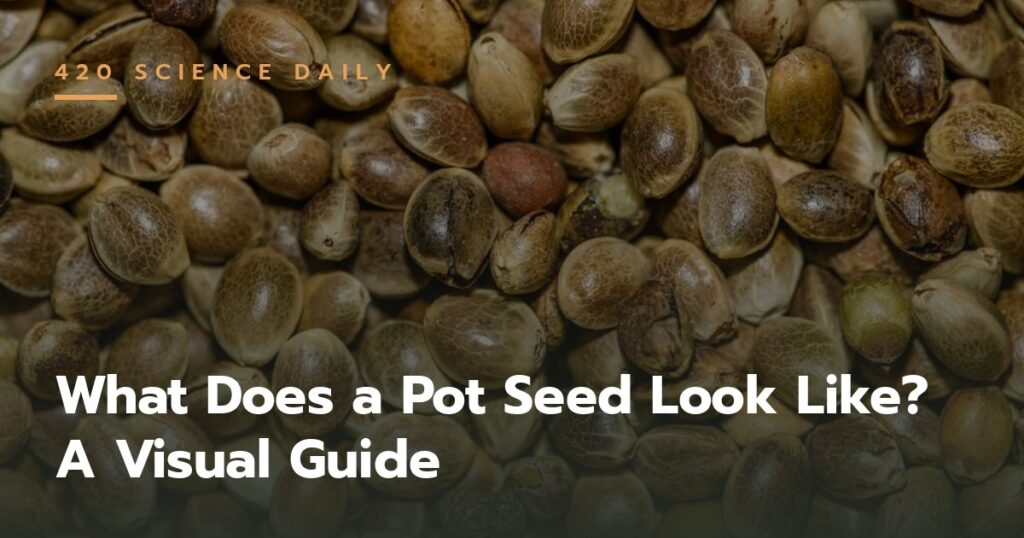
A pot seed looks like a tiny teardrop-shaped nut, about the size of a peppercorn. A healthy, mature one is hard to the touch, dark brown or grey-brown, and often marked with darker stripes or speckles that growers call “tiger stripes”. Pale green, white or soft seeds are usually immature and far less likely to sprout.
The short answer: A good pot seed is small (2–5 mm long), plump and teardrop-shaped, with a hard, smooth shell in shades of dark brown or grey, often with darker mottling or tiger stripes and a faint seam down one side. It should feel firm when you press it gently between thumb and forefinger — never soft, squishy or papery. Colour alone is not proof of quality, and looks can never tell you a seed’s sex, strain or potency.
If you have ever tipped a packet of seeds into your palm and wondered whether what you are looking at is normal, you are not alone. Cannabis seeds do not look like the seeds most people are used to — they are smaller than a sunflower seed, harder than a lentil, and their colouring varies so much from strain to strain that two perfectly healthy seeds can look quite different. This guide walks through exactly what a pot seed looks like, what each feature means, and which warning signs are worth taking seriously.
One thing to get straight first: botanically speaking, what growers call a cannabis “seed” is technically an achene — a one-seeded dry fruit in which the hard outer shell (the pericarp) is not tightly joined to the true seed inside. That shell is what you are actually looking at, and its colour, hardness and pattern are the clues this article is about.
What does a pot seed look like, exactly?
Picture a peppercorn that has been stretched slightly at one end. That is the basic shape: oval or teardrop, rounded at one end and gently pointed at the other, with a faint line running down one side like a seam. The surface is usually smooth, sometimes with a slight waxy sheen when you catch the light. Pick one up and it feels surprisingly hard and dense for its size — a healthy seed resists a gentle squeeze and does not dent.
The colour is where most beginners get confused, because there is no single “correct” colour. Mature seeds are most often tan, medium brown, dark brown or grey-brown, and a single seed can carry a mix of shades. Many — but by no means all — carry darker streaks, speckles or a marbled pattern across a lighter background. Growers call this tiger striping, and it is one of the most recognisable features of a mature seed.
But stripes are a clue, not a certificate. Some strains produce seeds that are very dark, almost black or even purple-black, with barely any visible pattern. Others run lighter, a pale tan or grey, and are perfectly fine. What matters is the combination: a plump shape, a hard shell, an intact surface and a mature colour for that strain. No single trait on its own settles the question.
Size is the most consistent feature. Across grow guides and seed-bank descriptions, healthy cannabis seeds measure roughly 2–5 mm long — about the size of a peppercorn or a matchstick head. If a seed in your batch is noticeably smaller, thinner or oddly shaped than its siblings, that is worth noting: underdeveloped seeds tend to be small and misshapen, and they struggle more often at germination.
How big is a cannabis seed — and what colour should it be?
Size and colour are the two things people check first, so it helps to know what the science actually says about them, rather than relying on seed-shop folklore.
On size, research on cannabis achenes shows real, measurable differences between plant types. In a multivariate study of herbarium specimens, Small and Naraine (2016) found that domesticated plants — both hemp and marijuana — produce achenes that are significantly longer and heavier than those of wild, ruderal plants, and that marijuana achenes tend to be about 26% shorter than hemp achenes. Fibre cultivars, meanwhile, produce achenes about 19% longer than oilseed cultivars. In plain terms: seed size varies by type and breeding history, so a small seed is not automatically a bad one — but a seed that is much smaller than others from the same batch probably did not finish developing.
On colour, the same study found marijuana achenes to be about 32 shades darker (on a 256-point greyscale) than hemp achenes, and that the seed coats of hemp are more resistant to cracking than those of marijuana plants. Darker does not mean better in any absolute sense — it is simply how the two groups differ on average. Within a single batch of one strain, though, the darker, fully coloured seeds are generally the mature ones, while the palest ones are the ones that were harvested too early.
Here is a quick colour key, with the caveat that strain variation is real and exceptions exist:
- Dark brown, grey-brown or near-black: usually mature. The most common look for a healthy seed.
- Tan or medium brown, with darker stripes or mottling: usually mature. Tiger striping is a normal feature of a finished seed coat.
- Very dark purple or purple-black: normal for some strains. Judge by firmness and shape, not by the unusual colour.
- Pale green or bright green: usually immature. The shell never hardened and darkened properly.
- White, cream or translucent: usually immature. These seeds rarely germinate, because the embryo inside never finished developing.
- Chalky, dusty or washed-out: often old or badly stored, even if the seed was once mature.
The practical rule is simple: colour is a maturity clue, not a quality guarantee. A dark seed can still be a dud if it is cracked or hollow, and a lighter seed from a pale-seeded strain can still sprout. Judge the whole seed — colour, shape, hardness and surface — together.
How can you tell a good pot seed from a bad one?
Looks cannot guarantee a seed will germinate. Only the germination test itself can do that. But looks can weed out the obvious duds before you waste time, soil and space on them. Run through these checks in order: look, feel, then decide.
Look. Hold the seed under a good light. A healthy seed is plump and symmetrical, with a smooth, intact shell. Check for cracks, chips or splits in the coat — damage matters because it lets moisture swing in and out too fast and gives mould an easy way in. A faint seam down one side is normal; an open split is not.
Feel. Press the seed very gently between thumb and forefinger. A good seed resists the pressure and keeps its shape. If it dents, feels soft or crushes easily, the shell is too weak and the embryo inside is unlikely to survive germination. If it feels papery or hollow, it probably never filled out properly. Do not squeeze hard enough to crack a good seed — the test is a gentle press, not a crush test.
Compare. Line your seeds up side by side. The odd one out — much smaller, much paler, flatter or more shrivelled than the rest — is the one to be suspicious of. Seeds from one batch of one strain should look broadly similar; a single seed that looks unfinished usually is.
| Trait | Healthy, mature seed | Likely dud |
|---|---|---|
| Colour | Dark brown, grey-brown or tan, often striped or mottled | Pale green, white, cream or chalky |
| Shape | Plump teardrop or oval, symmetrical | Flat, shrivelled, hollow-looking or misshapen |
| Size | Roughly 2–5 mm, similar to its batch-mates | Noticeably smaller or thinner than the rest |
| Shell | Hard, smooth, resists gentle pressure, slight sheen | Soft, brittle, cracked, chipped or easily crushed |
| Pattern | Often tiger-striped or marbled (but not always) | Plain, dull or slightly translucent, no pattern at all |
| Seam | Faint line down one side, closed | Open split or gaping seam |
Two popular home tests deserve a word of caution. The first is the float test: drop seeds in water, keep the sinkers, throw away the floaters. It is not reliable. Healthy seeds often float for hours because of air trapped in and around the shell, and some only sink after soaking. A floating seed is not a dead seed. The second is the crush test — squeezing a seed hard to see if it breaks. That only proves you can break a seed, including a good one. Stick to looking and a gentle press.
What if a seed fails the visual check but you plant it anyway? Sometimes it will still sprout — immature seeds are less likely to germinate, not guaranteed to fail. But if you have plenty of seeds, planting the best-looking ones first is the sensible use of your time. A seed that is pale, soft and cracked is a poor bet; a seed that is dark, hard and plump is a good one.
Do feminised, autoflower and regular seeds look different?
No — and this is one of the most common misunderstandings among new growers. Feminised, regular and autoflower seeds are visually identical. The difference between them is genetic, not cosmetic: feminised seeds are bred to produce female plants, autoflowers carry ruderalis genetics that make them flower by age rather than by light cycle, and regular seeds can grow into male or female plants. None of that shows up in the shell.
The same goes for indica, sativa and hybrid seeds. You cannot identify a strain — or a chemotype — by looking at a seed with the naked eye. There is one intriguing exception in the research literature: a 2022 study by Márquez and colleagues used geometric morphometrics (precise mathematical analysis of outline shape) on 91 achenes from five varieties and found that achenes from high-THC (Type I) varieties were rounded and bigger, while achenes from CBD-only (Type III) varieties were slender and smaller — distinct enough that shape alone could separate the chemotypes in their sample. But that was laboratory measurement with specialist software, and the authors themselves note that further studies are needed before shape could be used as a screening tool. It is not something you can do by eye at the kitchen table, and it says nothing about an individual seed’s potency. Treat seed appearance as a maturity check, not a strain test.
What you can sometimes tell from a seed is its type in the loosest sense — hemp seeds bred for fibre or oil tend to be larger and paler than marijuana seeds, as Small and Naraine’s measurements show — but again, that is a population average, not a home identification method. If the label matters to you, buy from a breeder you trust and keep the packaging. The seed itself will not tell you what is inside.
Can you tell a male seed from a female seed just by looking?
No. There is no reliable visual difference between male and female cannabis seeds. No dimple, crater, stripe pattern or shape quirk identifies a seed’s sex — despite the many charts and folk rules circulating online that claim otherwise. Sex in cannabis is determined genetically, and it only reveals itself once the plant grows and shows pre-flowers, usually several weeks after germination.
This is exactly why feminised seeds exist and why they are popular: they remove the roughly 50/50 uncertainty of regular seeds by breeding plants that almost always grow female. If you are growing regular seeds and only want females, the only honest approach is to grow them out and identify the males once they show themselves, then remove them before they can pollinate anything. No amount of staring at the seed beforehand will change that.
Be wary of any seller or guide that claims to sex seeds by appearance. It is the seed world’s oldest myth, and it survives because it sounds plausible — but every serious source, from seed banks to the morphology literature, agrees that it does not work.
What does a pot seed look like when it germinates — and how do you store seeds?
A germinating seed looks very different from a dormant one, and knowing the sequence helps you tell healthy progress from a problem. First the seed swells as it absorbs water — a process called imbibition — and the shell darkens slightly. Then a fine crack opens along the seam, and a small white taproot (the radicle) pushes out. That white root is the first sign of life, and it is also the most fragile part of the young plant: handle the seed by its shell, never by the root.
Temperature matters more than most beginners expect. In a 2022 study of industrial hemp at the University of Kentucky, Geneve and colleagues measured germination across temperatures from 3 to 42 °C and found the best results — the highest germination percentage in the shortest time — between 19 and 30 °C, with an optimum of about 29.6 °C and a base temperature of 3.4 °C. Seeds held at 3 °C did not germinate but recovered fully once moved to warm conditions; seeds held at 42 °C progressively lost viability and did not recover after four days. The study was on hemp rather than drug-type cannabis, but the two are the same species, and the practical lesson carries over: keep germination warm and steady, roughly 21–26 °C, and never let seeds bake. Our full step-by-step walkthrough is in our guide to how long it takes to germinate weed seeds.
Once that taproot appears and the seedling breaks the surface, the first leaves are a pair of small, rounded seed leaves (cotyledons), followed by the first serrated true leaves. If the seedling looks wrong at that stage — twisted, pale or stunted — our guide to weed seedling deformed leaves covers the most common causes and fixes, and our photo guide to a 3-week-old cannabis plant shows what healthy early growth should look like.
Storage is the other half of keeping seeds viable. A seed is a living thing in suspended animation, and three things wear it down: heat, moisture and light. Keep seeds somewhere cool, dark and dry, in a sealed container, with as little temperature swing as possible. A fridge drawer in an airtight jar with a silica gel packet is the classic home setup; a warm windowsill or a damp shed is the fastest way to ruin them. The researchers in the Geneve study stored their hemp seed in sealed plastic bags at 10 °C and used it within two years — a sensible benchmark for home storage too. Avoid handling seeds with wet hands, and do not leave them sitting in direct sunlight, which degrades the shell and the embryo inside.
When planting day comes, give the seed the best start you can. A light, well-aerated medium matters more than fertiliser at this stage — a seedling has its own stored energy reserves and needs oxygen and gentle moisture, not a heavy feed. If you mix your own soil, our super soil recipe is built for established plants rather than fresh seeds, so use a light seed-starting mix for germination and move up to richer soil once the plant has a few sets of true leaves.
One last note: cannabis laws differ widely by country and by state, and in many places growing cannabis — even from a single seed — is still illegal. This article is educational: it describes what seeds look like and how they behave. Check the law where you live before you germinate anything.
Disclaimer: This article is for educational purposes only and is not medical or legal advice. Cannabis laws vary by jurisdiction; check your local laws before growing. If you use cannabis for a medical condition, speak to a qualified clinician first.
Frequently asked questions
What does a pot seed look like?
A pot seed looks like a tiny teardrop-shaped nut, about 2–5 mm long — roughly the size of a peppercorn. A mature seed is hard, dark brown or grey-brown, often with darker tiger stripes or mottling, and has a faint seam down one side.
What does a healthy cannabis seed look like?
A healthy cannabis seed is plump and symmetrical, with a hard, smooth shell that resists gentle pressure. It is usually dark brown, grey-brown or tan, sometimes with tiger striping, and has no cracks, chips or soft spots. Colour varies by strain, so judge firmness and shape alongside colour.
What do bad cannabis seeds look like?
Bad or immature cannabis seeds are usually pale green, white or chalky, and often soft, flat, shrivelled or cracked. Seeds that crush easily between your fingers, or that are much smaller than the rest of the batch, are unlikely to germinate well.
Can you tell if a cannabis seed is male or female by looking at it?
No. There is no visible difference between male and female cannabis seeds. Sex is determined genetically and only shows once the plant grows and develops pre-flowers. Feminised seeds are the reliable way to grow female plants.
Do all pot seeds have tiger stripes?
No. Tiger stripes — darker streaks or marbling on the shell — are common on mature seeds but not universal. Some strains produce very dark, almost black seeds with little visible pattern, and some produce pale tan seeds. Stripes are a maturity clue, not a requirement: a hard, plump, uncracked seed without stripes can still be perfectly good.
Sources
- Small, E. & Naraine, S.G.U. (2016). A multivariate analysis of morphological divergence of “seeds” (achenes) among ruderal, fibre, oilseed, dioecious/monoecious and marijuana variants of Cannabis sativa L. Genetic Resources and Crop Evolution, 63(4), 703–714. https://doi.org/10.1007/s10722-015-0254-2
- Márquez, F. et al. (2022). Cannabis Varieties Can Be Distinguished by Achene Shape Using Geometric Morphometrics. Cannabis and Cannabinoid Research, 7(4), 409–414. https://pmc.ncbi.nlm.nih.gov/articles/PMC9418367/
- Geneve, R.L., Janes, E.W., Kester, S.T., Hildebrand, D.F. & Davis, D. (2022). Temperature Limits for Seed Germination in Industrial Hemp (Cannabis sativa L.). Crops, 2(4), 415–427. https://www.mdpi.com/2673-7655/2/4/29