

Cannabis has one of the most recognizable leaves in the plant kingdom — yet most people only know that single leaf shape, and the plant itself changes dramatically from a fragile seedling to a tall, bud-covered adult. If you are trying to identify a plant, track your own grow, or just satisfy curiosity, the leaf alone is not enough. The whole plant — its structure, its growth stages, and its sex — tells the real story.
The famous leaf — and what it does not tell you
The cannabis leaf is palmate, meaning its leaflets spread from a central point like fingers from a palm. A mature leaf typically has five to nine narrow, serrated leaflets, though young leaves may have just one or three, and some strains produce more. The leaves are green — ranging from lime to deep forest green — and they grow in pairs along the stem, with each new pair offset from the last.
But the leaf shape alone can mislead. Several unrelated plants have similar-looking leaves, and cannabis itself looks different depending on its type. Broad-leaf varieties (often called indicas) tend to have wide, dark-green leaflets and a short, bushy shape. Narrow-leaf varieties (often called sativas) tend to have thin, lighter-green leaflets and a tall, stretched shape. Hybrids fall somewhere in between. Leaf shape hints at type; it does not prove it, and it says nothing reliable about potency — a claim our guide to whether sativa is an upper or downer treats with the same caution for effects.
Stage by stage: how the plant changes
| Stage | What it looks like | What to notice |
|---|---|---|
| Seedling | A thin stem with two small, round seed leaves, then the first tiny serrated leaves | Extremely fragile; the classic leaf shape has not appeared yet |
| Vegetative | Rapid upward growth, branching, large fan leaves, strong green colour | The plant looks like a leafy bush or small tree; structure forms here |
| Early flowering | White hairs (pistils) appear at branch joints; growth stretches upward | The first sign of sex — hairs mean female, sacs mean male |
| Mid flowering | Buds form and swell along branches; smell becomes strong; leaves may yellow slightly | Bud sites cluster at branch tips and nodes |
| Late flowering / harvest-ready | Dense, frosty buds; many hairs turned orange-brown; fan leaves yellowing and dropping | Trichome colour, not hair colour, is the harvest signal |
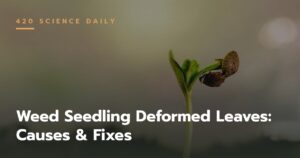
Seedlings surprise most people. The first leaves to emerge are not serrated at all — they are two smooth, oval seed leaves (cotyledons) that feed the plant until true leaves take over. The first true leaves have a single serrated leaflet, the next have three, and only later leaves develop the full five-to-nine fingered shape. If you found a seedling and expected the famous leaf, you would walk right past it.
Vegetative plants are where the classic image forms: a central stem with side branches, large fan leaves catching light, and steady upward growth. This is also when the plant’s overall shape says most about its type — short and bushy, or tall and open. Training techniques like topping change this shape deliberately, which is why our guide to when to top weed plants shows plants that look very different from untrained ones.
Flowering plants look like a different species to the untrained eye. Buds form where branches meet the stem and at branch tips, starting as small clusters of white hairs and swelling into dense, resin-coated flowers. By late flowering, a healthy female is heavy with buds, visibly frosty with trichomes, and strongly scented. Fan leaves often yellow and drop as the plant directs energy into the buds — this is normal late in flowering, not a sign of disease.
Male vs female: the difference that matters
Cannabis is dioecious, meaning individual plants are usually male or female, and only females produce the buds people harvest. Telling them apart matters because a single male can pollinate nearby females, turning bud production into seed production.
Females develop wispy white hairs (pistils) at the joints where branches meet the stem. These hairs catch pollen, and the buds grow around them. Males develop small, round pollen sacs that hang in clusters — they look like tiny grapes or bells and contain no hairs. The sacs open to release pollen. If you are growing for buds and you spot sacs, that plant is usually removed promptly.
Some plants develop both male and female flowers — hermaphrodites, usually triggered by stress such as light leaks, heat, or physical damage. These “hermies” can also pollinate a crop, which is one more reason to keep the growing environment stable.
Common lookalikes
Several plants get mistaken for cannabis, especially by people who only know the leaf:
- Japanese maple and other palmate-leaved ornamentals — similar fingered leaves, but woody, perennial, and lacking the serrated cannabis leaflet shape and smell.
- Okra and some hibiscus relatives — palmate leaves, but with large showy flowers and a completely different growth habit.
- Hemp vs marijuana — these are the same species, and you cannot tell them apart by looking. The legal distinction is chemical (THC content), not visual. A hemp plant and a marijuana plant can look identical.
- Tomato and other garden plants — sometimes confused at seedling stage, but tomato seedlings have a different leaf shape and a distinctive smell when brushed.
The smell test helps: crushed cannabis leaves have a distinctive herbal, skunky scent that lookalikes lack. But smell alone is not identification either — and if you are unsure whether a plant is cannabis, the safe assumption is that local law, not appearance, decides what you can do with it.
What the leaves say about plant health
Leaves are the plant’s dashboard. Learning to read them is the fastest way to spot trouble early:
- Leaves folding upward like a taco — usually heat or light stress. See cannabis leaves tacoing for the full breakdown.
- Yellowing starting from lower leaves — often nitrogen deficiency, or natural ageing late in flowering. Context (stage, pattern) decides which.
- Brown, crispy leaf tips — commonly nutrient burn from overfeeding.
- Spots, mold, or webbing — pests or disease. White powdery patches, bud rot, and other problems are covered in what moldy weed looks like and what bud rot looks like.
- Drooping leaves — usually a watering issue, most often overwatering rather than underwatering.
What a healthy plant looks like overall
Beyond individual stages, a healthy cannabis plant has a general look that becomes obvious once you have seen a few: upright stems that are sturdy rather than floppy, leaves held out flat to catch light rather than drooping or curling, and an even, vibrant green color across most of the foliage. Growth should be steady — a plant that stalls for weeks while its neighbors thrive is telling you something is wrong with its roots, its light, or its feeding, even if no single leaf looks dramatic.
Size and shape vary so much by strain and setup that there is no single “correct” silhouette, but proportion is a useful guide. A plant that is all stem and almost no leaves is stretching for light. A plant that is dense and bushy with leaves stacked on leaves may need airflow help to avoid mold problems later. And a flowering plant should look heavy by the end — buds swelling, branches starting to bow slightly under the weight, and the whole plant smelling strong. If a flowering plant looks thin and sparse at the stage when buds should be filling out, the usual culprits are weak light, poor feeding, or a harvest that is still weeks away and simply needs patience.
Frequently asked questions
What does a baby weed plant look like?
Nothing like the adult. A seedling has a thin stem, two small round seed leaves, and then tiny single-leaflet serrated leaves. The classic multi-fingered leaf only appears as the plant grows.
Can you tell indica from sativa by looking?
Only roughly. Broad, dark leaflets and a short, bushy shape suggest broad-leaf types; narrow, lighter leaflets and a tall shape suggest narrow-leaf types. Most modern plants are hybrids, so appearance is a hint, not a reliable label — and it predicts effects even less reliably.
How tall do weed plants grow?
It varies enormously: from under a metre for small indoor or autoflower plants to several metres for outdoor plants in a long season. Pot size, light, strain, and training all affect final height.
What do male weed plants look like?
Like females until flowering, when they grow small round pollen sacs in clusters at branch joints instead of white-haired buds. If you are growing for buds, males are usually removed before the sacs open.
Do weed plants smell before flowering?
Vegetative plants have a mild herbal smell when brushed, but the strong, distinctive cannabis smell develops mainly during flowering as buds and trichomes form.
Sources
- National Institute on Drug Abuse (NIDA) — cannabis plant and biology overviews.
- University of California Agriculture and Natural Resources — cannabis morphology and cultivation guidance.
- Health Canada — hemp vs cannabis plant information and legal distinctions.





1 response to “What Do Weed Plants Look Like? A Visual Guide”