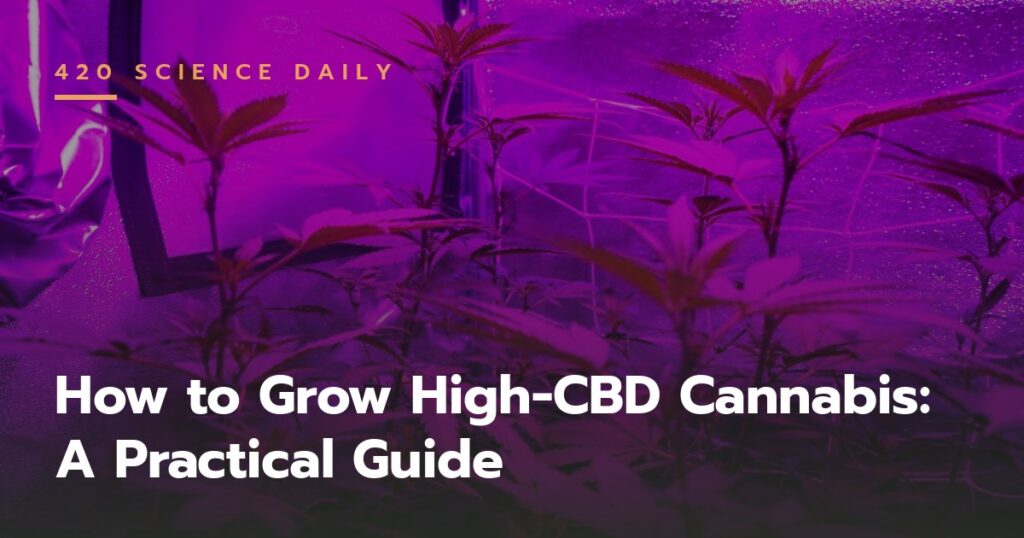
High-CBD cannabis is grown for a different goal than high-THC cannabis: instead of maximising intoxication, you want flower rich in cannabidiol (CBD) and low in THC. That single change of goal alters almost every decision — which seed you buy, when you harvest, and how you judge success. The most important thing to understand before you start is that CBD content is mostly decided by genetics. No growing trick turns a high-THC strain into a high-CBD one.
General information only. This article is not medical advice, and it makes no claims that CBD treats or cures any condition. If you use CBD for a health reason, discuss it with a clinician first.
Genetics first: the seed decides the ratio
Cannabis plants produce cannabinoids according to their genetics. Broadly, strains fall into three chemotypes: THC-dominant (high THC, low CBD), balanced (roughly equal THC and CBD), and CBD-dominant (high CBD, low THC). A CBD-dominant strain typically has a CBD-to-THC ratio strongly favoring CBD, but “low THC” does not mean “no THC” — most CBD flower still contains measurable THC, and in some places that is enough to make it legally marijuana rather than hemp.
Practical consequences follow. Buy seeds or clones from a source that publishes lab results (a certificate of analysis) for that specific strain, not just a marketing claim. Be sceptical of any strain advertised with an exact CBD percentage — cannabinoid content varies by plant, growing conditions, and testing lab, so a claimed figure is a guide, not a guarantee. And keep the seed packet and paperwork: if legality ever depends on the strain being hemp-type, documentation helps.
How to read a lab report before you buy seeds
A certificate of analysis (COA) is the document that separates a serious CBD seed seller from a marketing claim, and learning to read one takes five minutes. Look for four things. First, the CBD and THC percentages for that specific strain — not a generic company average — and check that the THC figure sits comfortably below your local legal limit, not right on it. Second, the lab’s name and accreditation: an independent, accredited lab’s report carries weight that an in-house test does not. Third, the date and batch: a report from two years ago for a different seed batch tells you little about what you are buying today. Fourth, the contaminant panel if one is included — pesticide, mold, and heavy-metal results matter because a clean cannabinoid profile means little if the flower itself is contaminated. If a seller cannot produce a COA at all, treat that as information in itself and buy elsewhere.
One caution applies to every number on a COA: cannabinoid content varies by plant, by growing conditions, and even between labs testing the same sample. A strain that tests at a given CBD percentage for the breeder may test somewhat higher or lower in your garden. Use the COA to choose genetics and to confirm the ratio direction — strongly CBD-dominant, not balanced or THC-leaning — rather than treating the exact percentage as a promise.
How growing for CBD differs from growing for THC
Day to day, a CBD plant is grown much like any cannabis plant — light, water, airflow, and light feeding. The differences are in emphasis:
| Decision | High-THC growing | High-CBD growing |
|---|---|---|
| Strain choice | THC-dominant genetics | CBD-dominant genetics with lab results |
| Harvest signal | Often waits for some amber trichomes | Often harvests at mostly cloudy, before THC climbs further |
| Success measure | Potency and bud density | CBD content and ratio, confirmed by testing |
| Legal risk | Depends on cannabis law | Depends on THC content — a CBD crop over the local THC limit can be legally marijuana |
| Training | Aggressive training for yield | Same techniques, but gentle with CBD autos — see when to top weed plants for timing |
The harvest-timing point deserves emphasis. As buds mature, cannabinoid profiles shift — CBD’s precursor compounds convert over time, and THC content can rise as the plant finishes. Growers aiming for CBD therefore often harvest on the earlier side of the window, when trichomes are mostly cloudy rather than waiting for substantial amber. The trade-off is real: earlier harvest can mean slightly lower total yield, but a profile closer to the intended CBD-dominant ratio. Checking trichomes properly matters here more than usual — our guide to what trichomes look like when ready to harvest shows the colour stages to watch.
Light, feeding, and environment for CBD plants
CBD plants have the same basic needs as any cannabis: strong light, good airflow, careful watering, and light feeding. A few points are worth extra attention when CBD is the goal:
- Do not chase yield with heavy feeding. Overfeeding stresses plants and can reduce quality. CBD growers in particular gain nothing from pushing nutrients hard — the cannabinoid ratio comes from genetics, not from fertiliser.
- Keep stress low. Heat, drought, pests, and light leaks stress plants and can trigger hermaphroditism (plants growing both male and female flowers), which seeds your buds. Stable conditions protect both yield and quality.
- Watch for mold. Dense CBD buds are just as vulnerable to mold and bud rot as any other flower. Good airflow and sensible humidity during flowering matter more than any spray. See what moldy weed looks like and what bud rot looks like for what to watch for.
- Prune for airflow, not for show. Removing a few large fan leaves that block light and air from the buds helps more than aggressive defoliation. Our guide to how to prune a weed plant covers the balance.
The legal trap: CBD flower is not automatically legal
This is where CBD growers get caught out. In many places, the law distinguishes hemp from marijuana by THC content — commonly a threshold around 0.3% THC by dry weight — not by CBD content or by what the seed packet said. A CBD-dominant plant that tests above the local THC limit is legally marijuana in that jurisdiction, whatever your intention was. And because cannabinoid content varies by plant and by growing conditions, a strain that tests compliant for the breeder can test over the limit in your garden.
Three practical steps reduce the risk: choose strains with a strong track record of testing well under the local limit (not just under it on paper), harvest on time rather than late, and — where it is available and legal — get your own harvest tested before assuming its status. Rules differ by state and country and are changing, so check the current law where you live rather than relying on general articles, including this one.
Drying, curing, and storing CBD flower
CBD flower is dried and cured exactly like THC flower: slowly, in the dark, with ventilation, then cured in sealed jars opened briefly each day at first. Rushing the dry degrades flavor and aroma regardless of cannabinoid content. One CBD-specific note: if you plan to make oil or edibles, the starting flower’s quality still matters — extraction concentrates whatever is in the flower, including any mold or pesticide residue, so starting clean is not optional.
Storage matters too. Light, heat, and air degrade cannabinoids over time, so cured flower keeps best in airtight containers in a cool, dark place. If you are comparing your home-grown CBD flower with shop-bought CBD products, remember that commercial products are usually made from extracted, standardized CBD — your flower is a whole-plant product with a different profile, and the two are not directly comparable in dose or effect.
Frequently asked questions
Can I turn a THC strain into a CBD strain by growing it differently?
No. Cannabinoid ratio is set by genetics. Growing conditions can shift the profile somewhat, but they cannot turn a THC-dominant plant into a CBD-dominant one. Start with CBD-dominant genetics.
Will high-CBD weed get me high?
CBD itself is not intoxicating in the way THC is, but most CBD flower still contains some THC, so effects vary by strain, ratio, and dose. Do not assume CBD flower has no THC — only a lab result can say what is actually in it.
When should I harvest CBD cannabis?
Most CBD growers harvest when trichomes are mostly cloudy, before substantial amber develops, to keep the profile CBD-dominant. Check trichomes with a loupe rather than relying on hair colour.
Do I need to test my CBD harvest?
Testing is the only way to know your actual CBD and THC content. It matters most if legality in your area depends on THC staying under a threshold, or if you want to know what dose you are actually getting.
Is growing CBD flower legal everywhere CBD oil is legal?
No. Many places regulate the plant and the extracted product differently. CBD oil may be sold legally while growing the flower at home is restricted or illegal. Check the law for cultivation specifically, not just for CBD products.
Sources
- National Institute on Drug Abuse (NIDA) — CBD and cannabinoid science overviews.
- Health Canada and US Food and Drug Administration (FDA) — hemp/CBD regulatory information.
- University of California Agriculture and Natural Resources — cannabis cultivation and chemotype guidance.