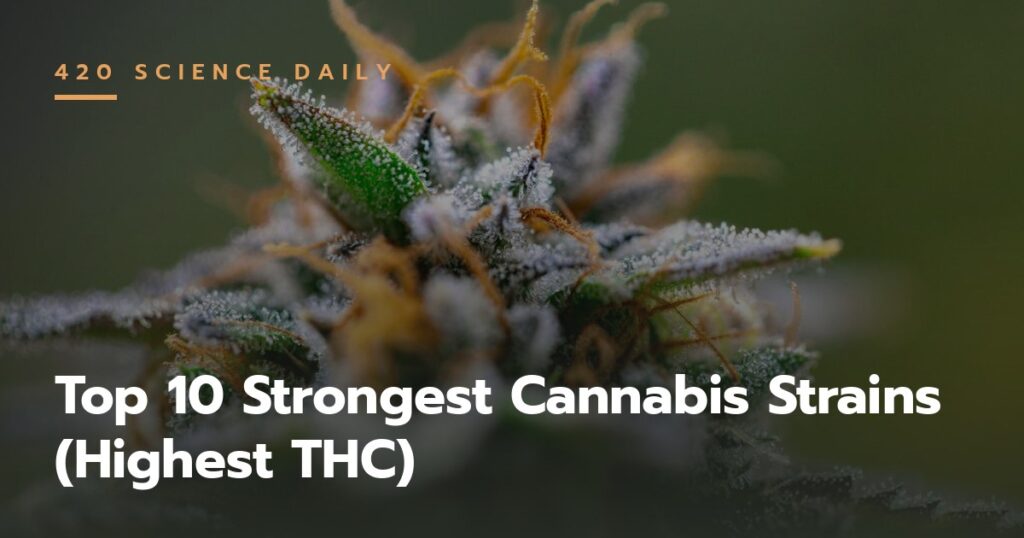
The short answer: The strongest cannabis strains currently reported — Godfather OG, Bruce Banner and Gorilla Glue #4 among them — have lab-tested THC figures reaching roughly 30–38% in the best batches, though most retail flower lands lower. But THC percentage alone is a poor predictor of how strong weed actually feels: terpenes, freshness, and lab variability matter at least as much.
| Strain | Reported THC range* | Type | Notable trait |
|---|---|---|---|
| Godfather OG | ~34% and above | Indica-dominant hybrid | Heaviest sedation on the list; couch-lock |
| Bruce Banner | ~25–35% | Sativa-dominant hybrid | Euphoric, creative energy before the body high |
| Gorilla Glue #4 | ~25–32% | Hybrid | Extremely resinous buds; euphoric then relaxing |
| Motorbreath | ~25–35% | Indica-leaning hybrid | Pungent diesel aroma; powerful body high |
| Grease Monkey | ~30–33% | Indica-leaning hybrid | Vanilla-diesel flavour; sleepy euphoria |
| Chemdawg | ~32% lab peaks; ~20% typical retail | Hybrid | Ancestor of Sour Diesel and OG Kush |
| Strawberry Banana | ~22–31% | Indica-dominant hybrid | Sweet tropical flavour; fast onset |
| Girl Scout Cookies | ~19–28% | Hybrid | Sweet, minty profile; genetics in half this list |
| GMO Cookies | ~22–30% | Indica-dominant hybrid | Garlicky funk; deep, prolonged body stone |
| Apple Fritter | ~22–28% | Hybrid | Dessert-like flavour; balanced high |
*All figures are approximate, based on widely reported lab results. Actual THC varies by grower, batch, phenotype and testing lab — always check the label on the product in front of you.
## Why is THC percentage not the whole story? Here’s the finding that reshaped cannabis science: **two samples with identical THC percentages can feel completely different.** The difference comes from terpenes — the aromatic compounds like myrcene, limonene and pinene that give each strain its smell — and how they interact with cannabinoids. The concept is the “entourage effect.” In a landmark 2011 review, Ethan Russo examined the pharmacological evidence and found that terpenoids and other phytocannabinoids meaningfully modulate THC’s effects — some enhancing desirable properties, others buffering against side effects like anxiety and short-term memory impairment (Russo, 2011). In other words, the 22% strain with a rich terpene profile can feel stronger, smoother, and more enjoyable than a flat, terpene-poor 30% strain. Freshness matters too. THC degrades over time into CBN when exposed to light, heat and oxygen, so a high-THC label on stale, poorly stored flower is mostly fiction. And as noted above, lab variability means the number on the package is best treated as a rough guide rather than a precise measurement. The practical takeaway: chase **terpene-rich, fresh, well-grown flower** from a strain you enjoy — not just the biggest number on the menu. ## How has cannabis potency changed over time? The strains above didn’t appear by accident. Modern cannabis is dramatically stronger than what previous generations smoked, and the data is unambiguous. The University of Mississippi’s potency monitoring programme — which has analysed tens of thousands of samples over decades — found that average THC in US cannabis rose from roughly 4% in 1995 to over 12% by 2014, with concentrated products testing far higher still (ElSohly et al., 2016). A follow-up analysis covering 2008–2017 confirmed the trend continued in both the United States and Europe, driven largely by the dominance of sinsemilla (unpollinated female) flower and selective breeding for THC (Chandra et al., 2019). What this means for you: the “strongest strains” of today would have been almost unthinkable thirty years ago. Tolerance, dosing, and caution all need to be calibrated to the modern reality — especially if your expectations were set by cannabis from an earlier era. ## How should you approach high-THC strains safely? Potency isn’t a scoreboard — it’s a dosing challenge. A few ground rules for anything on this list: **Start low, especially with a new strain.** High-THC flower rewards small doses; one or two inhalations with a 15-minute wait tells you more than a heroic first session. New users in particular should treat anything above ~20% THC with respect. **Know your anxiety threshold.** High doses of THC are reliably linked to anxiety, racing thoughts and paranoia in susceptible people — which is exactly [why high-THC cannabis is more likely to trigger paranoia in sensitive users](https://420sciencedaily.com/why-does-weed-make-some-people-paranoid/). If you’re prone to it, potent indicas and heavy hybrids are the riskiest category. **Don’t chase the number when you’re already too high.** Overconsumption with strong strains produces a genuinely miserable few hours — racing heart, nausea, dread. If it happens, read [what overdoing it actually feels like and what to do about it](https://420sciencedaily.com/can-you-smoke-too-much-weed/): you’ll be fine, it will pass, and there are concrete steps that help. **Remember edibles are a different beast.** A 25% flower joint and a 25mg edible are not comparable experiences — [edibles can feel even stronger than smoking](https://420sciencedaily.com/why-do-edibles-hit-harder-than-smoking/) because the liver converts THC into a more potent metabolite. Dosing rules for flower don’t transfer. **Tolerance builds fast.** Daily use of high-THC cannabis raises tolerance within days to weeks, which is how people end up needing ever-stronger strains for the same effect. Tolerance breaks — even short ones — reset the equation. Finally: none of this is medical advice, and high-THC cannabis isn’t risk-free. If you have a heart condition, a history of psychosis, or you’re pregnant, the strong-stuff list is one to skip entirely. ## Frequently asked questions ### What is the strongest strain of weed? The strain most consistently reported at the top is **Godfather OG**, with widely reported figures above 34% THC in exceptional batches. Bruce Banner, Gorilla Glue #4 and Motorbreath are usually close behind. But “strongest” depends on the batch — any individual sample’s potency depends on the grower, harvest and lab, so the label on the product matters more than the strain’s reputation. ### Which strain has the highest THC? By reported lab figures, Godfather OG holds the crown, with exceptional samples reported in the 34–38% range. That said, these are peak figures from standout batches, not typical retail numbers. Most flower sold under even the strongest strain names tests in the mid-20s — still very potent by historical standards. ### What THC percentage is considered strong? Anything above ~20% THC is considered strong by modern standards; above ~25% is very strong. For context, average legal-market flower in the US tested around 12–15% in the mid-2010s (ElSohly et al., 2016) — so today’s 25%+ strains are roughly double the strength of what was typical a decade ago. ### Does higher THC mean better weed? No — and this is the most important misconception in cannabis retail. Research on the entourage effect shows that terpenes and minor cannabinoids significantly shape the experience (Russo, 2011), meaning a terpene-rich 20% strain can feel better and subjectively stronger than a flat 30% one. Freshness, curing quality and the right strain for your body matter more than the number on the label. ### Are high-THC strains dangerous? Cannabis has no confirmed lethal overdose dose in humans — but “can’t kill you” isn’t the same as “can’t harm you.” High-THC strains are more likely to cause anxiety, paranoia, racing heart and nausea, especially in new or sensitive users. People with heart conditions, a personal or family history of psychosis, or who are pregnant should avoid high-THC cannabis. When in doubt, use less and talk to a clinician. ## Sources 1. Russo EB (2011). Taming THC: potential cannabis synergy and phytocannabinoid-terpenoid entourage effects. *British Journal of Pharmacology*, 163(7), 1344–1364. [https://www.ncbi.nlm.nih.gov/pmc/articles/PMC3165946/](https://www.ncbi.nlm.nih.gov/pmc/articles/PMC3165946/) 2. ElSohly MA et al. (2016). Changes in cannabis potency over the last 2 decades (1995–2014): Analysis of current data in the United States. *Biological Psychiatry*, 79(7), 613–619. [https://pubmed.ncbi.nlm.nih.gov/26903403/](https://pubmed.ncbi.nlm.nih.gov/26903403/) 3. Chandra S et al. (2019). New trends in cannabis potency in USA and Europe during the last decade (2008–2017). *European Archives of Psychiatry and Clinical Neuroscience*, 269, 5–15. [https://link.springer.com/article/10.1007/s00406-019-00983-5](https://link.springer.com/article/10.1007/s00406-019-00983-5)Reported THC figures in this article are approximate, compiled from widely published strain data (e.g. AllBud’s highest-THC strain roundup, [https://www.allbud.com/learn/story/10-highest-thc-cannabis-strains-2021-so-far](https://www.allbud.com/learn/story/10-highest-thc-cannabis-strains-2021-so-far)). Lab results vary — treat any percentage as a rough guide, not a guarantee. Last updated: 24 October 2026.