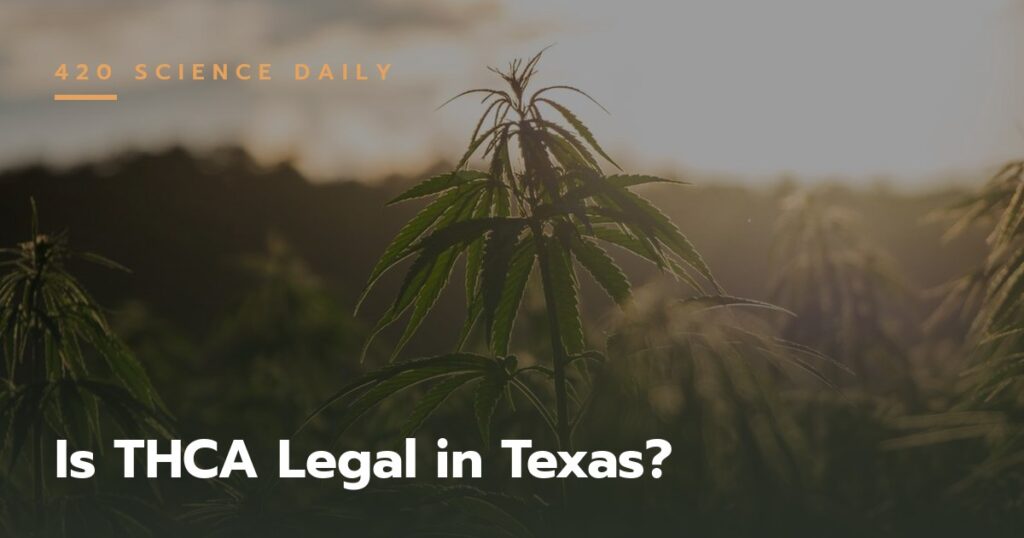
For years, Texas smoke shops sold THCA flower openly, marketed as legal hemp. Then, in the space of a few months in 2026, the ground shifted under it — a state Supreme Court ruling, a reinstated scheduling rule, and a new way of testing THC combined to end the THCA era in Texas.
Legal status as of 3 November 2026. Texas cannabis law is moving fast and parts of it are being fought in court — if you face a charge or a specific legal question, speak to a Texas criminal defence attorney.
What is THCA — and why was it ever sold as legal hemp?
THCA stands for tetrahydrocannabinolic acid. It is the raw, acidic compound that cannabis and hemp plants actually produce; delta-9 THC — the compound most people mean when they say “THC” — is what THCA becomes when it is heated. That conversion, called decarboxylation, happens when flower is smoked, vaped or baked. In its raw form, THCA is not intoxicating. Once heated, it is effectively THC.
That chemistry created the loophole. The 2018 federal Farm Bill removed hemp from the federal definition of marijuana, defining hemp as cannabis containing no more than 0.3% delta-9 THC by dry weight. Texas followed in 2019 with House Bill 1325, legalising hemp on the same definition. Crucially, the test counted delta-9 THC only — not THCA. So a flower bud could be packed with THCA, test under 0.3% delta-9 THC, and be sold as “hemp” — even though lighting it would deliver a full-strength THC experience. Retailers sold it openly across Texas for years, and many buyers reasonably assumed that a product on a shop shelf was legal.
It is worth understanding why regulators objected. The argument from the Texas Department of State Health Services (DSHS) was that the hemp law was never meant to protect concentrated or manufactured forms of THC simply because they started life as hemp, and that a product whose entire point is to become THC when heated is not what the 0.3% limit was designed to allow. That argument eventually won in court — which brings us to 2026.
What changed in Texas on 31 July 2026?
Three things came together in 2026, and it helps to keep them separate, because they do different jobs:
- 1 May 2026 — the Supreme Court ruling. In DSHS v. Sky Marketing Corp., the Texas Supreme Court held that DSHS has the authority to classify manufactured delta-8 THC as a controlled substance, rejecting the argument that the hemp definition shielded it. The ruling concerned delta-8, but it cleared the way for the wider scheduling action that followed.
- 10 July 2026 — the reinstated definitions. DSHS published its 2021 definitions of “tetrahydrocannabinols” and “marihuana extract” in the Texas Register (51 TexReg 4597). Those definitions had been frozen by litigation since 2021; the Supreme Court’s ruling lifted the freeze.
- 31 July 2026 — the effective date. The reinstated definitions took effect, making delta-8, delta-10, THCP, THC-O and HHC Schedule I controlled substances in Texas, and placing THCA flower among the banned products. USA Today reported the change in September 2026, listing THCA flower alongside delta-8 and delta-10 among the products Texas now bans.
The backstory matters too. In 2025 the Texas Legislature tried to settle the question directly: Senate Bill 3 would have banned nearly all consumable hemp products containing THC. Governor Greg Abbott vetoed it on 22 June 2025, arguing for strong regulation rather than a ban, and followed up with Executive Order GA-56 on 10 September 2025, directing tighter hemp rules — sales restricted to over-21s with ID checks, mandatory lab testing, QR-code labelling and child-resistant packaging. The 2026 change came not from new legislation but from the courts and the health department acting on definitions written years earlier — which is one reason it is still being challenged.
And challenged it is. In September 2026, a federal judge in Galveston declined an emergency request from hemp retailers to lift the ban, finding they had not shown irreparable harm, while their request for a preliminary injunction remained pending. Other industry lawsuits were also in progress as of autumn 2026, but none had blocked enforcement. That is the honest position: the ban is in force, and its challengers have not yet stopped it.
How does Texas test a product now? The total-THC rule
Even apart from the scheduling change, THCA flower would struggle to pass Texas’s current hemp test. Since 31 March 2026, Texas has measured total THC rather than delta-9 THC alone, under 25 Texas Administrative Code §300.101. The formula is:
Total THC = (0.877 × THCA) + delta-9 THC, which must stay at or below 0.3% by dry weight.
The 0.877 factor accounts for the weight lost when THCA converts into delta-9 THC on heating. For a CBD oil or a low-dose gummy, which contain almost no THCA, the change makes little difference. For THCA flower — where THCA is the whole point, often making up a large share of the bud’s weight — it is decisive: a flower that passed the old delta-9-only test now fails the total-THC test by a wide margin. This is why the two rules together closed the loophole so completely. A THCA product is caught by the scheduling definitions and, in most cases, by the testing standard as well.
There is one genuine grey area left, and it is worth naming rather than smoothing over. Some industry voices argue the reinstated definitions reach manufactured or non-delta-9 cannabinoids rather than naturally occurring THCA as such, and that the total-THC rule is the real mechanism catching THCA flower. State officials and most legal reporting treat THCA flower as banned regardless of that argument. For a buyer, the distinction makes no practical difference: either way, high-THCA flower cannot lawfully be sold in Texas right now, and treating it as legal would be a gamble on a court argument that has not yet succeeded.
THCA vs THC vs CBD vs delta-8: what is legal in Texas?
The table below compares the main cannabinoids as of November 2026. The pattern is simple: the law now sorts products by whether they are intoxicating hemp derivatives, not by whether they started as hemp.
| Product | What it is | Texas status (Nov 2026) | Why |
|---|---|---|---|
| THCA flower / concentrates | Raw cannabis flower high in THCA, which becomes THC when heated | Illegal to sell or possess as a hemp product | Caught by the reinstated DSHS definitions (effective 31 July 2026) and fails the total-THC test |
| Delta-9 THC (hemp-derived) | The standard THC compound, in gummies, drinks, tinctures and other edibles | Legal for adults 21+ | Stays within 0.3% total THC by dry weight, from a licensed retailer, with compliant labelling |
| CBD | Non-intoxicating cannabinoid, in oils, edibles and topicals | Legal | Hemp-derived CBD within the 0.3% total-THC limit remains a lawful hemp product |
| Delta-8 THC | Isomer of delta-9, usually manufactured from hemp-derived CBD | Illegal (Schedule I) | Classified as a controlled substance under the reinstated DSHS definitions since 31 July 2026; only naturally occurring trace amounts are permitted |
| Delta-10, THCP, THC-O, HHC | Other hemp-derived or semi-synthetic THC variants | Illegal (Schedule I) | Covered by the same scheduling action as delta-8 |
| Marijuana flower and edibles | Cannabis above the hemp THC limit, including out-of-state recreational products | Illegal | Recreational marijuana remains a criminal offence in Texas; only the narrow low-THC medical programme is exempt |
Two related bans are easy to confuse with the THCA ban. First, cannabinoid vape pens have been banned from retail sale in Texas since September 2025, so a THCA vape was already unlawful before the July 2026 change. Second, a statewide ban on selling smokable hemp (flower and pre-rolls) has been tied up in court — so qualifying low-THC delta-9 hemp flower may still appear on shelves while that fight continues. That does not help THCA flower: it is banned on its own terms, not by the smokable-hemp rule. Our guide to whether weed is illegal in Texas covers the wider picture, including penalties for marijuana itself.
What is still legal — and what happens next?
What remains legal is narrower than the old Texas hemp market, but it is not nothing. Hemp-derived delta-9 edibles, beverages and tinctures at or below 0.3% total THC remain on sale to adults 21 and over from licensed retailers, with lab certificates of analysis accessible on the label — the same market our guide to whether edibles are legal in Texas describes in detail. CBD products within the limit are likewise still lawful. What has gone is the intoxicating end of the hemp shelf: THCA flower, delta-8 and its cousins, and THC vapes.
The penalties are serious enough to take at face value. Banned THC products can be prosecuted as Penalty Group 2 controlled substances, with possession of less than one gram carrying state-jail-felony punishment of 180 days to two years and a fine of up to $10,000, according to USA Today’s September 2026 reporting. That is the same harsh category that has always applied to THC concentrates in Texas, and it is why a product that looks like ordinary flower can carry a felony charge. Businesses caught selling prohibited products also risk fines, loss of their hemp licences and criminal charges.
Practical rules follow from that. Do not bring THCA flower into Texas from a state where it is legal — Texas law applies inside Texas regardless of where you bought it, and out-of-state purchases offer no protection. Do not assume a shop still stocking THCA is operating lawfully; enforcement takes time to reach every retailer, and a shelf is not a legal opinion. And if you are subject to drug testing, note that standard tests screen for THC metabolites, and because THCA becomes THC when heated, THCA products can produce a positive result — the “it’s only THCA” argument does not survive a lab test.
Finally, watch December. At the federal level, Congress has moved to redefine hemp with a cap of just 0.4 milligrams of total THC per container — a level far below a standard 10 mg hemp gummy — and the effective date was pushed back from 12 November to 11 December 2026 by a federal spending bill signed in autumn 2026, to give Congress more time to decide how the products should be regulated. If that federal rule takes effect as written, it would end most of the remaining hemp-THC market nationwide, not just in Texas. Congress could still change or delay it, and Texas’s own court fights could still shift the state picture — but as of November 2026, the direction of travel at both levels is toward a smaller, more tightly controlled hemp market. Buyers and sellers should check the current rules before acting, not last year’s.
One last caution for anyone tempted by the unregulated end of the market: products sold outside the licensed system carry the usual quality risks of an unregulated market, including contamination — which is why it is worth knowing what mouldy weed looks like before buying flower from any source that is not properly tested and labelled.
Frequently asked questions
Is THCA legal in Texas in 2026?
No. As of November 2026, THCA flower and high-THCA products are not legal in Texas. The state’s reinstated controlled-substance definitions took effect on 31 July 2026, and a total-THC testing rule in force since March 2026 counts THCA toward the 0.3% limit, so high-THCA flower fails the hemp test. Court challenges are pending but none had blocked enforcement as of autumn 2026.
Is THCA flower legal in Texas?
No. THCA flower is specifically among the products Texas now bans, alongside delta-8, delta-10, THCP and similar hemp-derived THC products. This is distinct from low-THC delta-9 hemp flower, whose retail sale is separately tied up in court — THCA flower is banned on its own terms.
Can you buy THCA online and ship it to Texas?
Not lawfully. Ordering THCA flower online does not change its Texas legal status: possession in Texas is what the law governs, and retailers shipping THCA into Texas are supplying a product the state treats as a controlled substance. Some out-of-state sellers still ship to Texas addresses, but that is a seller’s risk decision, not a legal safe harbour for the buyer.
Is THCA legal federally?
For now, the federal picture is different from Texas’s — but it is closing. Under the 2018 Farm Bill, hemp is defined by a 0.3% delta-9 THC limit, and THCA has historically fallen inside the federal hemp definition. A new federal hemp definition, currently scheduled to take effect on 11 December 2026, would replace that test with a total-THC standard and a 0.4 mg per-container cap, which would end most THCA products federally as well unless Congress changes course. And federal legality never overrides a stricter state ban: Texas can be, and is, stricter.
Does THCA show up on a drug test?
Yes, it can. Standard drug tests screen for THC metabolites, not for THCA specifically. Because THCA converts to THC when heated, smoking or vaping THCA flower produces the same metabolites as smoking marijuana, and can return a positive result. Raw, unheated THCA is a different question, but it is not the way most THCA products are used — and it does not change the product’s legal status in Texas.
Sources
- Addison, B. D. (2026). “President Trump delays federal hemp ban. What it means for Texas” — USA TODAY (8 September 2026). Texas ban effective 31 July 2026; THCA flower, delta-8, delta-10 and THCP banned; state-jail-felony penalties; federal effective date delayed to 11 December 2026. https://www.usatoday.com/story/news/state/texas/2026/09/08/trump-federal-hemp-ban-texas-thc-marijuana/91657833007/
- Texas Supreme Court (2026). DSHS v. Sky Marketing Corp., decided 1 May 2026 — DSHS’s authority to classify manufactured delta-8 THC as a controlled substance; reinstated definitions published in the Texas Register, 51 TexReg 4597 (10 July 2026), effective 31 July 2026 (as reported by USA TODAY, 2026, above).
- Agriculture Improvement Act of 2018 (the 2018 Farm Bill), Pub. L. 115-334 — federal hemp definition: cannabis with no more than 0.3% delta-9 THC on a dry-weight basis, removed from the federal definition of marijuana (as summarised by USA TODAY, 2026, above).
- Texas Administrative Code, Title 25, §300.101 — total-THC calculation, (0.877 × THCA) + delta-9 THC ≤ 0.3% dry weight, in effect since 31 March 2026 (as reported in Texas hemp-law coverage, 2026).
Internal links used (all verified live on 3 November 2026): Is Weed Illegal in Texas? The Law in 2026 Explained; Are Edibles Legal in Texas? (2026 Guide); What Does Moldy Weed Look Like? A Safety Guide to Spotting Contaminated Cannabis.

1 response to “Is THCA Legal in Texas? The 2026 Law Explained”