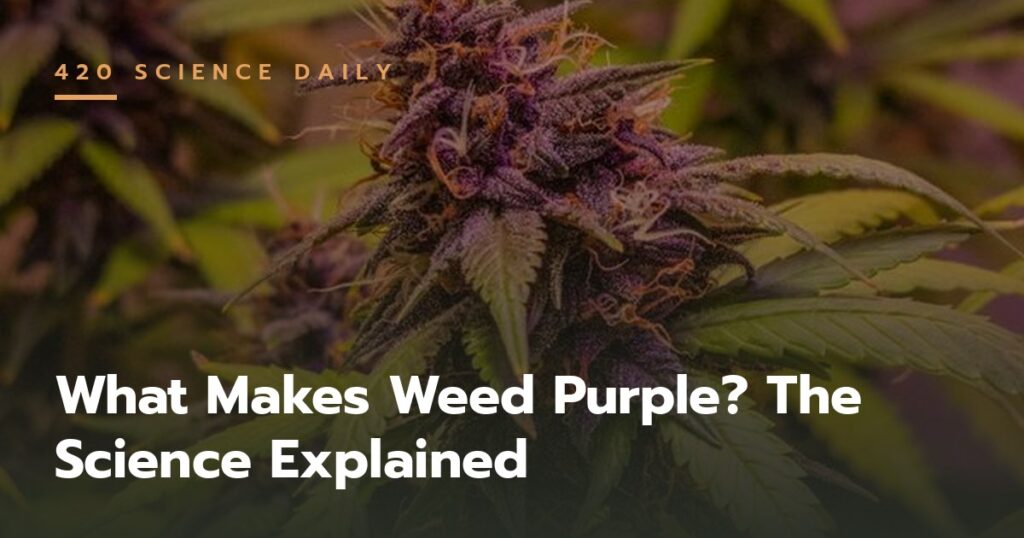
Purple buds photograph beautifully, and they sell a story: rare genetics, extra potency, a premium smoke. Some of that story is true. The colour is real, the genetics behind it are real, and the science of why it appears has finally been measured in cannabis itself rather than borrowed from blueberries. But the part about purple weed being stronger is not. This guide explains what actually makes weed purple, when the colour is a sign of good breeding, and when it is a plant asking for help.
The short answer: Weed turns purple because of anthocyanins, a family of flavonoid pigments — the same pigments that colour blueberries and red cabbage. In cannabis the main one is cyanidin-3-rutinoside, also called keracyanin. Genetics decide whether a plant can make enough of it to show; cool temperatures late in flowering can bring the colour out further. Purple does not mean stronger: the pigment has nothing to do with THC.
What pigment actually makes weed purple?
The purple in weed comes from anthocyanins, water-soluble pigments stored in the vacuoles of plant cells. They are the reason for most red, blue and purple colouring across the plant kingdom, from autumn leaves to aubergines. Cannabis makes them too, but until recently nobody had pinned down exactly which one mattered most in this species.
That changed in 2023, when Laura Bassolino and colleagues at the Italian research centre CREA measured anthocyanins in green and purple cannabis tissue using targeted HPLC-MS/MS analysis. They identified cyanidin-3-rutinoside — keracyanin — as the major anthocyanin in both the leaves and the flowers, the first time it had been identified as cannabis’s dominant pigment. The numbers show how dramatic the difference is. In one genotype they studied, purple leaves held 1,187.27 mg of total anthocyanins per 100 g of fresh weight, against just 3.00 mg in green leaves from the same trial. Purple flowers held 360.13 mg per 100 g. Those figures describe specific experimental samples, not an average for every purple strain, but they settle the basic question: purple weed is not a different kind of plant, it is a plant that builds far more of the same pigment.
Anthocyanins do not sit in the resin. They build up mainly in the outer layers of leaves and bracts, underneath the trichomes, which is why a purple bud still looks frosty white on top — the sparkling trichome coat sits above the coloured tissue. That is also why colour alone tells you nothing about resin content: the two systems are built in different parts of the plant.
One more property of anthocyanins matters for growers trying to read their plants. The same pigment can look red, purple or blue depending on acidity: it reads redder in acidic conditions and bluer as pH rises. That is why anthocyanin-rich cannabis can range from pinkish-red through violet to deep blue-purple, and why two plants of the same strain can show slightly different hues in different soils or feeds.
Is purple weed genetic, or does cold weather cause it?
Genetics first, weather second. That is the short version, and a 2024 study shows why. Kristina Gagalova and colleagues grew four differently coloured cannabis varieties under uniform conditions at a licensed producer in British Columbia and compared their leaves. Two varieties showed pronounced red-purple pigmentation, one showed a moderate amount, and the fourth showed none at all — same light, same feed, same room. The difference tracked with the activity of the plants’ anthocyanin-building genes: the genes 4CL, CHS, F3H, F3’H, FLS, DFR, ANS and OMT showed the strongest correlation with how much pigment accumulated. In other words, the capacity to go purple is written into the plant. A strain that lacks the machinery will stay green whatever you do to it.
That is the foundation the famous purple strains are built on. Granddaddy Purple, usually described as a cross of Purple Urkle and Big Bud and popularised in the San Francisco Bay Area in the early 2000s, is the best-known example, alongside Purple Kush and Purple Haze. Breeders selected these lines over generations precisely because they express anthocyanins heavily in the flowers. If you want purple buds, choosing one of these genetics is the only reliable route — and it is worth remembering that strain names alone are a weak guide to effects, as our guide to strains of weed and their effects explains: what matters is the chemical profile inside the bud, not the label on the jar.
Cold does play a role, but it is a dial, not a switch. In many plants, cool temperatures switch on the genes that build anthocyanins, and cannabis follows the same pattern — up to a point. The clearest test so far came in 2025, when Sean Kim and colleagues at the University of Wisconsin grew a genetically purple, day-neutral cannabis line in growth chambers held at steady temperatures from 0.5°C to 22°C for 30 days. Anthocyanin accumulation peaked at constant temperatures of 8°C and 15°C, at roughly 68 and 58 mg/L in the extracts measured. At the warmest treatment, 22°C, pigment levels were low. Surprisingly, they were also low at near-freezing 0.5°C: chilling the plants almost to freezing did not make them purpler, it stopped the colour developing.
That finding cuts against the most common grower advice, which is to drop night temperatures hard in the last weeks of flowering. The warm-day, cold-night swing did not beat steady cool in that trial either: plants held at a constant 8°C or 15°C made significantly more pigment than plants put through fluctuating temperatures. And there was a cost to chasing colour. In the same study, the cool conditions that maximised pigment produced lighter flowers and less CBD than the warmer treatments — total CBD and inflorescence dry weight both rose with temperature. So a grower who pushes temperatures down for colour may be trading yield and cannabinoids for a prettier bud. One caution: the trial used a single inbred hemp line and did not measure THC, so its results describe how temperature affects pigment in that population, not a universal recipe for every strain.
Timing matters too. Colour often deepens late in flowering, for two reasons at once: anthocyanin production changes as the plant matures, and chlorophyll — the green pigment — starts to break down, which unmasks the purple underneath. The same unmasking is what turns maple leaves red in autumn. A plant that looks mostly green in week five can show real purple by week eight without anything having gone wrong.
Can pH and light change the colour?
Yes, both can shift the colour, though neither creates it from nothing. As noted above, anthocyanins change hue with acidity, so the pH of the root zone and the plant’s internal chemistry can nudge a purple strain towards red or towards blue. This is a subtle effect, not a tool for forcing colour: chasing a particular shade by swinging pH risks locking out nutrients, which causes far worse problems than a slightly different tint.
Light matters more directly. Anthocyanin production in plants is strongly influenced by light, and specific wavelengths — especially blue and ultraviolet light — can increase the expression of the genes involved in building the pigment. That is one reason outdoor plants, exposed to full-spectrum sunlight including UV, often colour up more vividly than the same strain grown under older indoor lights. It is also why the purple tends to appear on the parts of the plant that actually receive light: shaded lower buds on the same plant often stay green while the top colas turn violet. If only the sun-facing side of a bud is purple, that is light doing its work, not a problem.
None of this overrides genetics. Light and pH can only modulate what the plant is already capable of producing. A green strain under strong UV light with perfect pH will still be green.
When is purple a warning sign, not a trait?
Not all purple is genetic. The most common lookalike is phosphorus deficiency, and telling the two apart matters because one needs no action and the other needs a fix.
A phosphorus shortage darkens the lower, older leaves to a dull blue-green, then brings purple or reddish tints to the stems, the leaf stalks (petioles) and the undersides of leaves. As it advances, bronze or brown patches spread across the leaf, the edges curl down, and growth slows — in flower, the plant struggles to build dense buds, because phosphorus drives flower development. The pattern is the giveaway: phosphorus is a mobile nutrient, so the plant pulls it from old growth to feed new growth, and the symptoms start low and work upwards.
That pattern is almost the opposite of genetic purpling, which shows up in the flowers and sugar leaves late in flowering, on an otherwise healthy, vigorous plant, often most strongly where the light hits. Cold root zones complicate the picture: when soil temperatures drop below roughly 15°C, phosphorus uptake slows sharply even when the nutrient is present in the medium, so a cold plant can show deficiency symptoms without any shortage in the feed. Wrong pH does the same thing by locking phosphorus out — which is why the first step is always to check that the root zone is in range (roughly 6.0–6.5 in soil) and warm enough, before adding any bloom booster. Adding more phosphorus to a plant that cannot absorb it only trades one problem for another.
Here is a practical test. If the purple is in the buds and upper leaves of a known purple strain, the plant is growing fast, and the stems and lower leaves look normal, it is almost certainly genetics. If the purple is on the stems and the undersides of older, lower leaves, the foliage looks dark and dull, and growth has stalled, treat it as a possible deficiency: warm the root zone, check pH, and only then consider feeding. Growers who train their plants through the vegetative stage will already be watching growth rates closely — our guide to when to top weed plants explains why a plant that has stopped growing vigorously should not be stressed further, and the same logic applies here: do not stack a nutrient change on top of a plant that is already struggling.
| Cause | What turns purple | When it appears | Plant health | What to do |
|---|---|---|---|---|
| Genetics (anthocyanins) | Buds, sugar leaves, sometimes fan leaves | Late flowering; stronger in light-exposed areas | Healthy, vigorous growth | Nothing — this is the trait |
| Cold temperatures | Leaves and buds of a genetically purple strain | Late flowering, cool nights | Healthy if mild; yield can drop if pushed too cold | Keep nights cool, not freezing; do not chase colour at the cost of yield |
| pH / light shifts | Hue shifts red or blue; sun-facing buds colour first | Throughout flowering | Healthy | Nothing — minor modulation of the same pigment |
| Phosphorus deficiency | Stems, leaf stalks, undersides of older lower leaves | Any stage, often in flower | Slow growth, dull dark foliage, bronze patches | Warm the root zone, check pH (6.0–6.5 in soil), then feed if needed |
Is purple weed stronger than green weed?
No — and this is the most persistent myth in the whole subject. Anthocyanins are pigments. THC and CBD are cannabinoids. They are made by different biochemical pathways, stored in different parts of the plant, and there is no known mechanism by which making more pigment would raise THC. No study has found a link between purple colour and higher potency, and the 2025 temperature trial points the other way if anything: the plants that made the most pigment were not the ones with the most CBD. In that study the warmest treatment, 22°C, produced the highest CBD and the heaviest flowers while making the least pigment, and the authors found no correlation between anthocyanin levels and CBD. The study did not measure THC, and it used one hemp line, so it cannot prove anything about THC directly — but it is the best controlled evidence available, and it gives no support at all to the idea that purple means stronger.
Why does the myth survive? Partly because the most famous purple strains, like Granddaddy Purple, genuinely are potent — but they are potent because breeders selected them for high THC as well as for colour, not because the colour causes the potency. A green strain bred for high THC will out-test a purple strain bred for looks every time. Partly it survives because purple buds tend to come from careful growers who also cure well, so the smoking experience is better for reasons that have nothing to do with the pigment.
The honest way to judge any flower, purple or green, is the same: look at the trichomes, smell it, and in a legal market read the lab report. Our guide to what good weed looks like lays out the full checklist — vibrant colour with purple or orange accents is a good sign, but frosty trichome coverage, a strong strain-specific smell and a clean cure matter far more, and only a certificate of analysis can tell you the actual THC percentage. Colour is a feature of the flower, not a measure of it.
How can you tell real purple weed from stressed purple weed?
Put the checks together and the answer is usually obvious. Real genetic purple appears in the buds first, deepens late in flowering, is strongest where light falls, and comes with a plant that is otherwise thriving — new growth every day, healthy green fan leaves apart from the purple, and dense flowers forming normally. It often runs in the strain: if the breeder lists purple colouring as a trait, or the same cut has gone purple in previous runs, that is your answer.
Stress purple looks different in almost every respect. It starts on the stems and the undersides of older leaves rather than in the buds. It arrives with dull, dark foliage and slow growth rather than vigour. It may appear suddenly after a cold snap, a watering mistake or a pH swing, rather than building gradually through late flowering. And it is often patchy and uneven, following the pattern of whatever went wrong rather than the pattern of the light.
If you are still unsure, wait a few days and watch what changes. Genetic colour deepens steadily and the plant keeps growing. Deficiency purple spreads to more leaves, growth stalls further, and bronze patches appear. The waiting is not wasted time — it is the diagnosis. And if the plant is a seedling or in early vegetative growth and already turning purple, genetics are unlikely to be the explanation: purple from breeding shows in the flowers, not in a young plant that has barely started growing.
One last note for buyers rather than growers: purple weed on a dispensary shelf is almost always genetic. A commercial grower with a phosphorus problem does not get purple buds to market — they get a poor harvest. So when you are choosing flower, the question is not whether the purple is real. It is whether the bud behind the colour is well grown, well cured and lab-tested. Buy the chemistry, not the colour.
Frequently asked questions
What makes weed purple?
Anthocyanins, a family of flavonoid pigments — the same pigments that colour blueberries and red cabbage. In cannabis the main one is cyanidin-3-rutinoside (keracyanin), identified as the dominant pigment in a 2023 study. Genetics decide whether a plant can make enough to show, and cool temperatures late in flowering can intensify the colour.
Why is my weed purple?
Most often because of the strain’s genetics — purple varieties are bred to produce large amounts of anthocyanins, and the colour deepens late in flowering as chlorophyll breaks down. Cool nights can bring it out further. But if the purple is on the stems and the undersides of older, lower leaves, and growth has slowed, it may be a phosphorus deficiency or cold root zone instead.
Does cold make weed purple?
It can intensify purple in a strain that is genetically able to make anthocyanins, but it cannot turn a green strain purple. A 2025 controlled trial found pigment peaked at steady temperatures of 8°C and 15°C, and fell away both at 22°C and at near-freezing 0.5°C — so colder is not always purpler, and pushing temperatures too low can cost yield and CBD.
Is purple weed stronger?
No. There is no evidence that purple colour means higher THC. Anthocyanins and cannabinoids are made by different pathways in different parts of the plant. In a 2025 temperature study, the plants with the most pigment did not have the most CBD, and the study found no correlation between the two. Judge flower by its lab-tested THC and CBD numbers, trichomes and cure — not by its colour.
What strain is purple weed?
There is no single “purple weed” strain — purple colouring appears across many varieties bred for it. The best known are Granddaddy Purple, Purple Kush and Purple Haze, all selected over generations for heavy anthocyanin expression in the flowers. When buying, check the strain’s description for purple colouring as a listed trait, and remember the name alone says little about effects: the cannabinoid and terpene profile is what matters.
Sources
- Bassolino, L., Fulvio, F., Pastore, C., Pasini, F., Gallina Toschi, T., Filippetti, I., & Paris, R. (2023). When Cannabis sativa L. turns purple: Biosynthesis and accumulation of anthocyanins. Antioxidants, 12(7), 1393. https://pubmed.ncbi.nlm.nih.gov/37507932/ — peer-reviewed study identifying cyanidin-3-rutinoside (keracyanin) as the major anthocyanin in cannabis; purple leaves measured 1,187.27 mg total anthocyanins per 100 g fresh weight vs 3.00 mg in green leaves. DOI: 10.3390/antiox12071393.
- Kim, S. R., Basnet, P., Kovaleski, A. P., & Ellison, S. L. (2025). Anthocyanin accumulation, inflorescence dry weight and total cannabidiol content have different temperature optima in Cannabis sativa. Journal of Cannabis Research, 7, 51. https://pubmed.ncbi.nlm.nih.gov/40731014/ — controlled growth-chamber trial: anthocyanin peaked at 8°C and 15°C, fell at 0.5°C and 22°C; CBD and flower weight rose with temperature; no pigment–CBD correlation. DOI: 10.1186/s42238-025-00311-w.
- Gagalova, K. K., Yan, Y., Wang, S., Matzat, T., Castellarin, S. D., Birol, I., Edwards, D., & Schuetz, M. (2024). Leaf pigmentation in Cannabis sativa: Characterization of anthocyanin biosynthesis in colorful Cannabis varieties. Plant Direct, 8(11), e70016. https://pmc.ncbi.nlm.nih.gov/articles/PMC11588432/ — four varieties under uniform conditions showed pigmentation tracked anthocyanin-gene activity (4CL, CHS, F3H, F3’H, FLS, DFR, ANS, OMT). DOI: 10.1002/pld3.70016.
Disclaimer: This article is for education only and is not medical advice. Cannabis laws vary by country and region — check the rules where you live before growing, buying or using it. If you use cannabis for a health condition, speak to a qualified healthcare professional first.
Last updated: 20 November 2026