The short answer: Store cannabis seeds somewhere cool, dark, dry and airtight. A sealed jar with a silica gel packet, kept in the back of a fridge at around 4–8°C, keeps most seeds viable for five years or more. Room temperature works for a year or two at most, and a freezer can stretch storage to a decade — but only if the seeds are properly dried first.
A cannabis seed looks inert. It is a hard little shell, quiet in the palm of your hand, and it can sit in a drawer for months without visibly changing. But it is alive. Inside that shell is an embryo, breathing slowly, burning through a small store of energy, and waiting for the right signal to grow. Every day in storage, that embryo ages. The conditions around it decide whether it ages slowly — staying ready to sprout for years — or quickly, until one day it simply does not wake up.
That is why storage matters so much, and why it is worth getting right. A packet of seeds is an investment, sometimes a rare one: a strain that is no longer sold, a cross you bred yourself, a gift from a friend. Losing it to a warm windowsill or a damp cupboard is a quiet waste. The good news is that keeping seeds alive is not complicated. The science is clear, the method is simple, and the equipment costs almost nothing.
Why Do Cannabis Seeds Lose Viability in Storage?
To store a seed well, it helps to know what is happening inside it. A seed is a plant in suspended animation. It has finished growing, dried itself down, and shut its metabolism to a trickle. In that state it can wait — but it cannot wait forever. Three things wear it down: moisture, heat and time, with light and oxygen adding to the damage.
Moisture is the biggest threat. A seed that absorbs water starts to wake up. Its respiration rate climbs, it burns through its stored energy, and if the moisture is high enough it may even try to germinate inside its container. Damp storage also invites mould. Fungi such as Aspergillus and Penicillium thrive on stored seed, and once they take hold they can destroy a batch outright. This is why the first rule of seed storage is always the same: keep them dry.
Heat is the second enemy. Warmth speeds up every chemical reaction inside the seed, including the slow decay of its cells. A seed stored at 20°C ages roughly twice as fast as the same seed stored at 15°C, and the effect compounds. This relationship was formalised decades ago by the seed physiologist James Harrington, whose rules of thumb still underpin modern seed banking: seed life roughly halves for every 5°C rise in storage temperature, and halves again for every 1% rise in seed moisture content (Harrington, 1972).
Light is a lesser but real problem. Seeds evolved to germinate underground, in darkness. Light can act as a false signal, nudging a dormant seed towards germination, and ultraviolet light degrades the seed coat over time. Oxygen, meanwhile, slowly oxidises the fats stored inside the seed. Interestingly, in the most careful study of cannabis seed storage ever published, removing oxygen made no measurable difference — temperature and moisture were what mattered (Small & Brookes, 2012). That is a useful finding, because it means you do not need vacuum equipment or nitrogen flushing. A good airtight jar is enough.
The key point is that these factors work together. A seed that is dry but warm will last longer than a seed that is damp and warm, but not as long as a seed that is dry and cold. Get both right — dry and cold — and the seed’s internal clock slows to a crawl.
What Temperature and Humidity Should Cannabis Seeds Be Stored At?
The short answer is: as cool and dry as you can manage without freezing damp seed. But “cool and dry” is vague, so here are the numbers that the research actually supports.
The most useful cannabis-specific evidence comes from a 2012 study by Ernest Small and Brenda Brookes at Agriculture and Agri-Food Canada. They stored seeds of industrial hemp, a medicinal marijuana strain and a wild ditchweed strain at four temperatures (20°C, 5°C, −20°C and −80°C) and three moisture contents (about 11%, 6% and 4%) for 66 months — five and a half years — and tested germination throughout. The results were stark. Seeds stored at 11% moisture and 20°C lost all germination within 18 months, in every variety tested. But either drying the seeds to 6% moisture or cooling them to 5°C preserved germination for the full 66 months. Cooling further, to −20°C or −80°C, added only a small extra benefit (Small & Brookes, 2012).
That study gives us the two levers that matter: moisture and temperature. Either one alone, done properly, buys years. Both together buy the most. The same pattern shows up in the wider seed science. Harrington’s rules of thumb, published in the US Department of Agriculture’s Principles and Practices of Seed Storage (1972), state that seed life halves for each 5°C increase in storage temperature and for each 1% increase in seed moisture content, within the ranges of 0–50°C and 5–14% moisture. His practical shortcut, still quoted by seed banks today, is the “100 rule”: add the storage temperature in Fahrenheit to the relative humidity percentage, and keep the total under 100. A fridge at 40°F with 30% humidity inside the container totals 70 — comfortable. A garage at 75°F and 65% humidity totals 140 — and seeds age fast there.
The professional standard goes further still. The Food and Agriculture Organization’s Genebank Standards for Plant Genetic Resources for Food and Agriculture (2014) set out how the world’s seed banks preserve their collections: dry seeds to equilibrium at 5–20°C and 10–25% relative humidity, seal them in airtight containers, and store base collections at −18°C (±3°C) and 15% (±3%) relative humidity. Active collections — the ones breeders draw from regularly — are kept refrigerated at 5–10°C. Cannabis is an orthodox seed, meaning it tolerates drying and freezing, so these standards apply to it just as they apply to wheat or rice (FAO, 2014; Parihar et al., 2014).
For home storage, the practical targets fall out of all of this quite neatly:
- Temperature: 4–8°C (a normal fridge) for long-term storage; 15–20°C or below for short-term storage. Avoid anywhere above 25°C for more than a few weeks.
- Relative humidity inside the container: aim for roughly 20–30% for short-term storage and lower — around 10–20% — for the long term. Do not over-dry: guidance from seed sellers and the wider seed literature suggests that pushing moisture far below about 8% can itself shorten a seed’s life.
- Stability matters as much as the numbers. A seed kept at a steady 20°C will outlast one that swings between 5°C and 25°C every day. That is why the back of a fridge shelf beats the door, and why a cool cupboard beats a sunny windowsill.
| Storage method | Temperature | Humidity inside container | Expected viability |
|---|---|---|---|
| Room temperature (dark cupboard) | 18–22°C | Below 40% | 1–2 years |
| Refrigerator (sealed jar + desiccant) | 4–8°C | 10–30% | 5+ years |
| Freezer (sealed, fully dried seed) | −18°C | Below 10% | 10+ years if done properly |
| Warm, humid, or sunny spot | Above 25°C | Above 60% | Months — viability falls fast |
These viability figures are ranges, not promises. They assume healthy, mature seed from a reputable source, stored as described. Old seed, immature seed, or seed that was damp when it went into storage will fall short of them. And note what the Small & Brookes study showed: seed stored warm and damp was dead within 18 months, while the same seed stored cold or dry was still going strong after five and a half years. The difference between a drawer and a fridge is not a small one — it is the difference between a season and half a decade.
Which Container Is Best for Storing Cannabis Seeds?
The container is your seed’s only defence against the outside world. It has three jobs: keep moisture out, keep light out, and keep the air around the seeds still. Anything that does all three will work, and the best options are cheap and easy to find.
A small glass jar with a tight-fitting lid is the classic choice, and for good reason. Glass does not breathe, it does not absorb moisture, and it does not react with anything. A jam jar or a small mason jar with a rubber-sealed lid is ideal. The one weakness of glass is that it is transparent, so the jar itself must live in the dark — inside a cupboard, inside the fridge, or wrapped in a cloth or placed inside an opaque box. Amber glass jars solve this by blocking light, which is why many seed banks use them.
Small airtight plastic containers also work, provided they genuinely seal. Look for containers with a rubber gasket in the lid. Cheap snap-top tubs that flex or rattle are not airtight and will let humid air creep in over months. Whatever you use, the test is simple: if you can smell anything through the closed lid, air is getting through, and so is moisture.
Zip-lock bags are a useful second layer rather than a first choice. Squeeze the air out, seal the bag, and put it inside a jar or an opaque tub. The bag adds a moisture barrier and the jar adds protection from light and crushing. Vacuum-sealed bags go a step further and are popular with collectors, but remember the Small & Brookes finding: removing oxygen made no measurable difference to cannabis seed longevity. Vacuum sealing is harmless and convenient, but it is not the thing that saves your seeds. Dryness and cold are.
Whatever container you choose, add a desiccant — a small silica gel packet. One packet per container is enough. It absorbs stray moisture inside the jar and keeps the relative humidity low. Do not overdo it: too much desiccant can pull moisture below safe levels and damage the embryo. Use a packet that says it is food-safe or indicating (the kind that changes colour when it is saturated), and replace it if it changes colour or feels damp. Rice is sometimes suggested as a home desiccant, but it is far less effective than silica gel and can itself carry mould spores — skip it.
Avoid storing seeds in their original paper envelopes for the long term. Paper breathes, which is fine for a few weeks in a dry drawer but useless against humidity over months. If you want to keep the breeder’s packaging, put the whole sealed packet inside your airtight jar instead.
| Container | Airtight? | Light-proof? | Best for |
|---|---|---|---|
| Glass jar, sealed lid | Yes | No — store in the dark | Everyday long-term storage |
| Amber glass jar | Yes | Mostly | Best all-round option |
| Sealed plastic tub (gasket lid) | Yes, if well made | Depends on colour | Good, light and cheap |
| Zip-lock bag, air squeezed out | Nearly | No | Second layer inside a jar |
| Vacuum-sealed bag | Yes | No | Collectors; add an opaque outer layer |
| Paper envelope | No | Yes | Short-term only (weeks) |
How to Store Cannabis Seeds Step by Step
Here is the method, from the moment seeds arrive to the day you take them out again. It works whether you are storing them for six months or six years.
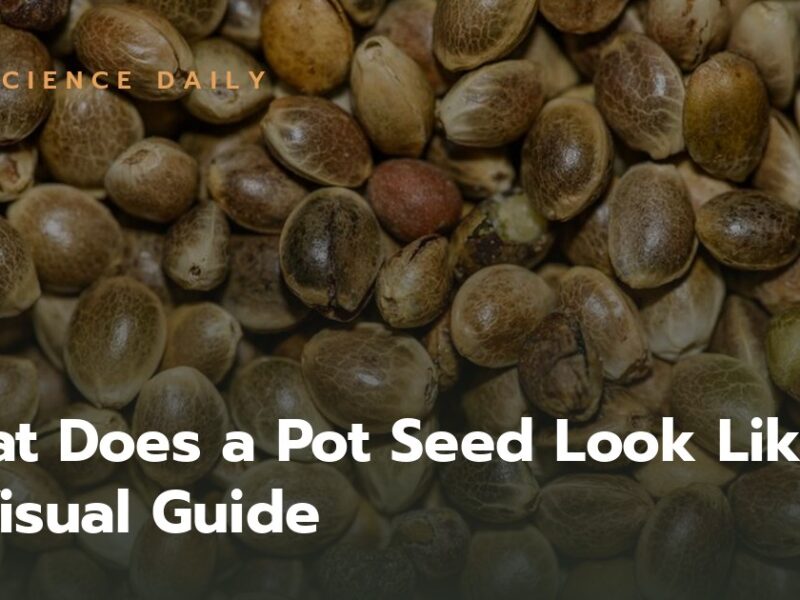
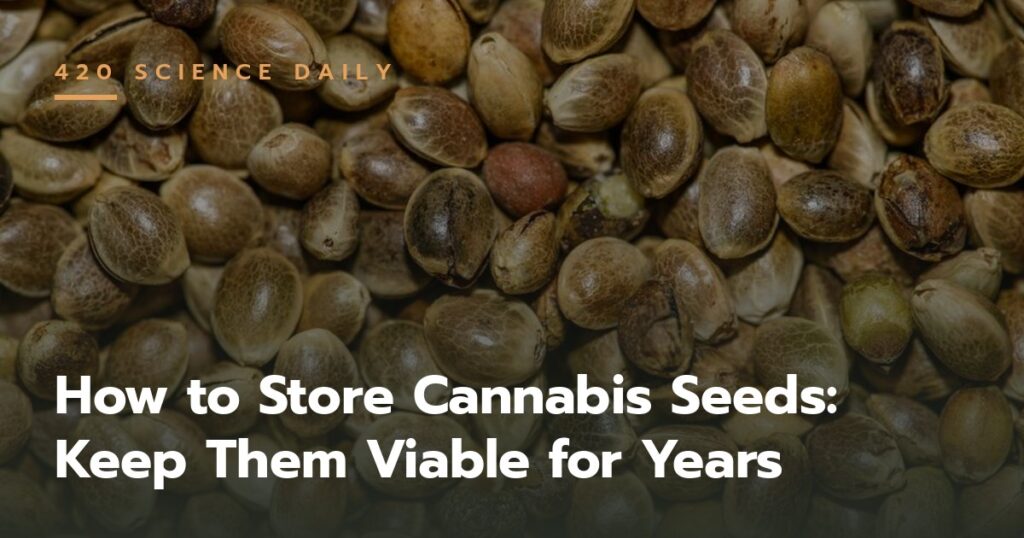
Step 1: Inspect the seeds. Tip them onto a clean white plate under a bright light. Healthy, mature cannabis seeds are usually dark — deep brown, grey or near-black, often with a mottled or tiger-stripe pattern — and feel hard when you press them gently between thumb and forefinger. Pale green or white seeds are usually immature and unlikely to germinate, however well you store them. Cracked or crushed seeds should be used first, if at all, because a damaged shell lets moisture and mould in. If you are storing seeds you collected yourself, let them dry first: spread them on a plate in a cool, dark, well-ventilated room for a few days. Never use heat to dry seeds — no oven, no microwave, no direct sun. Heat kills the embryo.
Step 2: Dry them down. Seeds bought from a breeder are usually already dried to a safe moisture level, but seeds you harvested yourself need that air-drying period. The goal is a seed that feels dry and hard, not soft or pliable. If you are unsure, a silica gel packet in the container will finish the job over a few days. What you are aiming for is roughly 6% internal moisture for long-term storage — the level Small & Brookes found preserved germination for over five years (Small & Brookes, 2012).
Step 3: Pack them. Put the seeds in your airtight container with one small silica gel packet. If you are storing several strains, use separate small containers or separate labelled bags inside one jar, so you never have to open the whole collection to take out one strain. Fill the container reasonably full — less empty space means less trapped air — but do not crush the seeds.
Step 4: Label everything. Write the strain name, breeder, and the date the seeds were bought or harvested on the container. A strip of masking tape and a marker pen is all it takes. Seeds all look alike after a year, and an unlabelled jar is a mystery you will regret. If you know the harvest date, note that too — it tells you how old the seed really is.
Step 5: Put the container somewhere cool, dark and stable. For storage up to a year or two, a dark cupboard or drawer in a cool room will do. For anything longer, use the fridge. Place the jar at the back of a shelf or in the crisper drawer, where the temperature is steadiest, not in the door where it swings every time someone reaches for the milk. If your fridge is opened constantly, wrap the jar in a towel or bubble wrap for extra insulation against temperature swings. A second, little-used fridge is ideal if you have one.
Step 6: Leave them alone. This is the hardest step. Every time you open the container you let in warm, humid air and oxygen, and you disturb the stable conditions you worked to create. Seal the jar and forget about it until you are ready to plant. If you want to admire your collection, do it through the glass — or better, keep a written inventory and leave the jar shut.
Step 7: Bring them back gently. When you are ready to germinate, take the container out of the fridge or freezer and let it warm to room temperature before opening it. This takes an hour or two. If you open a cold jar in a warm room, moisture from the air condenses on the cold seeds — exactly the dampness you spent years avoiding. Once the jar is at room temperature, open it, take out the seeds you need, reseal the rest, and put them straight back.
Common mistakes to avoid
Most stored seeds die for boring, avoidable reasons. Here are the ones that come up again and again:
- Storing them warm and damp — a sunny windowsill or a humid bathroom cupboard kills viability within months.
- Leaving them in a paper envelope — paper breathes, so humidity creeps in over time.
- Opening the jar to check on them — every opening lets in warm, humid air.
- Freezing damp seed — water inside the seed expands as ice and ruptures its cells.
- Opening a cold jar straight from the fridge — moisture condenses on the cold seeds; let it warm to room temperature first.
Should You Store Cannabis Seeds in the Fridge or Freezer?
This is the question every grower asks, and the answer depends on how long you plan to store them.
For most people, the fridge is the right answer. A normal fridge runs at about 4°C, which sits squarely in the range Small & Brookes found preserved germination for over five years. It is cold enough to slow ageing dramatically, warm enough that freezing damage is impossible, and — crucially — it is a place you already have. Put a sealed jar with a silica gel packet at the back of a shelf, and you are done. The main risks are temperature swings from the door opening and humidity from the fridge itself, which is why the airtight container and the desiccant matter so much. A frost-free fridge is better than an old one that ices up, because frost-free models keep the air drier.
The freezer is the long-game option. At −18°C, the FAO’s genebank standard for base collections, seed ageing slows to a near-standstill, and properly stored seed can remain viable for a decade or more. Small & Brookes tested −20°C and found it gave a small extra benefit over 5°C, on top of the large benefit of cooling itself. But the freezer has a hard rule: the seeds must be properly dry before they go in. Water inside a seed expands as it freezes, and ice crystals can rupture the cells that make the seed alive. Damp seed in a freezer is dead seed. If you are going to freeze, dry the seeds thoroughly first, use a genuinely airtight container, and ideally double-bag them. And never take seeds in and out of the freezer repeatedly — each freeze-thaw cycle risks condensation and damage. Freeze once, and leave them frozen until you need them.
Room temperature is the fallback, not the plan. If you will plant within a few months, a dark cupboard in a cool room is fine. Beyond a year, the odds start to turn against you — and remember, the Small & Brookes study showed warm, damp seed losing all viability within 18 months. A cool cupboard is a place to keep seeds while you decide what to grow next, not a place to keep a collection.
One place to avoid entirely is the garage, the attic or the garden shed. Temperatures there swing wildly between day and night and between seasons, and humidity follows the weather. A seed stored in a shed in summer is being cooked; the same seed in winter may freeze damp and crack. If the fridge is not an option, a cool interior cupboard is always better than any outbuilding.
How Long Do Cannabis Seeds Last in Storage?
There is no single expiry date for a cannabis seed, because the answer depends on the seed and how it was kept. But the research and the experience of growers point to a consistent picture.
At room temperature in a dark, dry cupboard, expect good germination for about one to two years. After that, germination rates start to fall — not all at once, but steadily. Some seeds will still pop after three years; many will not. In the Small & Brookes study, seed stored warm and damp was entirely dead within 18 months, which shows how quickly things go wrong when moisture is high. Kept dry at room temperature, seed lasts longer than that, but the fridge is still a large improvement.
In a fridge, in a sealed jar with a desiccant, five years is a realistic expectation, and many growers report strong germination well beyond that. The Small & Brookes trial ran for 66 months and found germination preserved at 5°C, which supports the five-year figure directly. With good seed and stable conditions, seven or eight years is not unusual.
In a freezer, properly dried and sealed, ten years or more is achievable. The FAO’s genebank standard stores base collections at −18°C precisely because, at that temperature, orthodox seeds can last decades. That is the institutional timescale, and a home freezer will not match a seed bank’s controlled drying — but the direction of travel is clear: colder and drier means longer.
Ageing is not just about whether a seed germinates, but how well it does. Older seeds germinate more slowly and produce weaker seedlings, even when they do pop. So if you have old seed, sow a few extra — where the law allows — and expect a slower start. That is normal biology, not a mistake on your part.
How to tell if stored seeds are still viable
Looks can mislead. A seed can look perfect — dark, hard, well-patterned — and still be dead inside, because viability fades invisibly. The only reliable test is to try to germinate a few of them.
The paper towel test is the standard method. Take a small sample — say, five or ten seeds — and place them between damp (not wet) paper towels, in a sealed bag or container, in a warm dark place at about 22–25°C. Check daily. Healthy seeds usually show a taproot within two to five days. Count how many germinate and divide by the number you tested: if eight out of ten pop, your batch is at roughly 80% viability. That tells you how many to sow to get the plants you want. Our guide on how long it takes to germinate weed seeds explains the timing and the methods in detail.
There are a few visual clues worth knowing, even though none of them is proof. Dark, hard, tiger-striped seeds are the best bet; pale, green or white seeds are usually immature. A seed that cracks or crumbles when pressed gently is dead. A seed with visible mould, a soft spot, or a musty smell should be discarded — and do not store it next to healthy seed, because mould spreads.
Skip the float test. Dropping seeds in a glass of water and judging them by whether they sink or float is popular online, but it measures density, not life. A seed can float and still germinate, or sink and still be dead. The paper towel test takes a few days longer and actually answers the question.
If your test shows poor germination, do not throw the whole batch away at once. Old seed sometimes needs more time, and a longer soak — 12 to 24 hours in plain water — can help a dried-out shell rehydrate. Research on hemp found that soaking sped germination up but did not raise the final germination rate in normal seed lots, so it will not rescue seed that is truly dead (Geneve et al., 2022). But it is worth trying before you give up on a rare strain. If nothing pops after ten days, the seed has most likely failed, and the honest move is to start fresh.
Frequently Asked Questions
How long do cannabis seeds last?
It depends on storage. At room temperature in a dark, dry place, cannabis seeds usually stay viable for one to two years. In a sealed jar with a desiccant in the fridge (4–8°C), five years or more is realistic — a Canadian study found germination preserved for over five years at 5°C. In a freezer at −18°C, properly dried and sealed, seeds can last ten years or longer. Warm, damp storage can kill seeds within 18 months.
Can you store cannabis seeds in the freezer?
Yes, but only if the seeds are properly dry first. At −18°C, seed ageing slows to a near-standstill, and the FAO’s genebank standard uses this temperature for long-term base collections. The danger is moisture: water inside a seed expands as ice and can rupture its cells. Dry the seeds thoroughly, seal them airtight with a desiccant, freeze them once, and let the container warm to room temperature before opening it.
Can you store cannabis seeds in the fridge?
Yes — the fridge is the best option for most growers. Keep seeds in a sealed jar with a silica gel packet, at the back of a shelf or in the crisper drawer where the temperature is steadiest, around 4–8°C. Avoid the door, where temperatures swing every time it opens. Stored this way, seeds commonly stay viable for five years or more.
How do you know if cannabis seeds are still good?
Look is only a rough guide: dark, hard, tiger-striped seeds are the best bet, while pale, soft or mouldy seeds are usually dead. The only reliable test is germination — place a sample between damp paper towels in a warm, dark place and count how many show a taproot within two to five days. The float test (sinking versus floating in water) is not a reliable measure of viability.
Do cannabis seeds need to be stored in the dark?
Yes. Seeds evolved to germinate underground, and light can act as a false signal that nudges them towards germination, while UV light degrades the seed coat. Store seeds in an opaque container, or keep a clear jar inside a dark cupboard or fridge. Total darkness is the aim, and it costs nothing to achieve.
Storing cannabis seeds well is a small job with a large payoff. A sealed jar, a silica gel packet, a label and a spot at the back of the fridge — that is the whole method, and it is backed by the best seed science available, from Harrington’s rules of thumb to a five-year trial on cannabis seed itself. The seeds you put away today could be the plants you grow in five years’ time. Treat them like the living things they are, and they will wait for you.
Before you buy or store seeds, it helps to know what a healthy seed looks like in the first place — our guide on what a pot seed looks like shows the colour, size and pattern to expect. And when the time comes to use them, our beginner’s step-by-step guide to growing weed picks up from germination through to harvest.
Sources
- Small, E. & Brookes, B. (2012). Temperature and Moisture Content for Storage Maintenance of Germination Capacity of Seeds of Industrial Hemp, Marijuana, and Ditchweed Forms of Cannabis sativa. Journal of Natural Fibers, 9(4), 240–255. https://doi.org/10.1080/15440478.2012.737179
- Harrington, J. F. (1972). Principles and Practices of Seed Storage. Agriculture Handbook No. 506, US Department of Agriculture. https://www.govinfo.gov/content/pkg/GOVPUB-A-PURL-gpo28758/pdf/GOVPUB-A-PURL-gpo28758.pdf
- Food and Agriculture Organization of the United Nations (FAO) (2014). Genebank Standards for Plant Genetic Resources for Food and Agriculture. Rome: FAO. https://www.fao.org/docrep/019/i3394e/i3394e.pdf
Supporting references cited in the text: Geneve, R. L. et al. (2022). Temperature Limits for Seed Germination in Industrial Hemp (Cannabis sativa L.). Crops, 2(4), 415–427; Parihar, S. S. et al. (2014). Effect of seed moisture content and storage temperature on seed longevity of hemp (Cannabis sativa). The Indian Journal of Agricultural Sciences, 84(11), 1303–1309.
Disclaimer: This article is general information, not legal advice. Cannabis seeds can be legally bought and kept as souvenirs in some places — in the UK, for example, seeds themselves are not a controlled drug, but germinating them is illegal. In the United States, the rules vary by state. Always check the law where you live before buying, storing or germinating cannabis seeds, and only germinate where home cultivation is legal for adults.