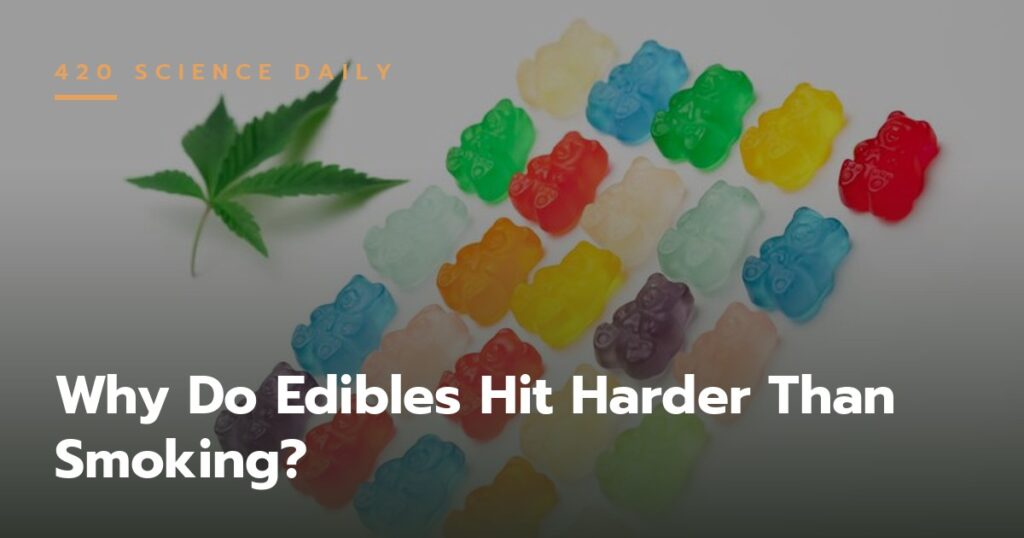
Ask around and you’ll hear the same story: someone eats a 10mg gummy, feels nothing after an hour, eats a second one “just in case” — and then the evening goes completely sideways. Meanwhile, smoking a comparable amount feels strong but manageable, and it’s over in a few hours.
This isn’t imagination, and it isn’t just about the dose. When you eat cannabis, your liver runs a chemistry experiment that smoking skips entirely — and the product of that experiment is a different, harder-hitting molecule.
The short answer
When you smoke, THC travels lungs → bloodstream → brain, arriving mostly as delta-9-THC.
When you eat cannabis, THC travels gut → liver → brain. In the liver, enzymes convert a large share of it into 11-hydroxy-THC — a metabolite that reaches the brain easily and looks to be more potent than delta-9-THC itself.
Different route, different molecule, different timeline, different high.
What happens when you smoke cannabis
Smoking is the express lane. THC vaporizes, crosses from your lungs into your blood within seconds, and reaches your brain in minutes.
- Onset: minutes
- Peak high: roughly 30–90 minutes
- Back to baseline: around 4 hours
- Bioavailability: roughly 10–35% of the THC, depending on how deeply you inhale
Here’s the key detail: because inhaled THC bypasses the liver on its first pass through the body, very little 11-hydroxy-THC gets made. Blood tests show a delta-9-THC to 11-hydroxy-THC ratio of about 10:1 after smoking (Huestis, 2007). The high you feel is overwhelmingly plain delta-9-THC — fast in, fast out. For a gentler inhaled option, compare smoking vs vaping cannabis.
What happens when you eat an edible
Edibles take the scenic route. THC is absorbed through your digestive tract and carried straight to the liver through the portal vein before it ever reaches your brain. This detour is called first-pass metabolism, and it changes everything.
Liver enzymes — mainly from the CYP2C9 family — convert much of the delta-9-THC into 11-hydroxy-THC. After an edible, the blood ratio of delta-9-THC to 11-hydroxy-THC is roughly 1:1. Compared with smoking, your brain is meeting a far larger share of the potent metabolite.
The timeline stretches out accordingly:
- Onset: 30 minutes to 2 hours
- Peak high: 2–4 hours
- Duration: 6–8 hours or more
- Bioavailability: roughly 4–20% — lower than smoking, but the metabolite makes up for it
Meet 11-hydroxy-THC, the real reason edibles feel different
11-hydroxy-THC isn’t in the cannabis plant at all. Your body manufactures it. And it’s unusually good at its job:
- It crosses the blood-brain barrier readily, reaching CB1 receptors efficiently.
- In animal studies, it has shown 1.5 to 7 times the potency of delta-9-THC at producing cannabinoid effects, depending on the model.
- A study in the Journal of Pharmacology and Experimental Therapeutics found 11-hydroxy-THC displayed equal or greater activity than THC in mice — 153% as active in a pain-response test.
- In an early human experiment, volunteers given equal 1mg intravenous doses felt faster onset and more intense effects from 11-hydroxy-THC than from delta-9-THC.
So the “edibles feel more psychedelic and heavier” reports have a plausible chemical explanation: you’re not just getting THC slower — you’re getting a meaningful dose of a stronger compound.
Timing is everything (and the trap)
| Smoking / vaping | Edibles | |
|---|---|---|
| Onset | Minutes | 30 min – 2 hours |
| Peak | 30–90 min | 2–4 hours |
| Duration | 2–4 hours | 6–8+ hours |
The delay is where most bad experiences come from. Nothing at 60 minutes → second dose → both doses peak together around hour three. “Start low, go slow” isn’t caution theater — it’s pharmacokinetics.
Why the same milligrams feel so different
A few more pieces of the puzzle:
- The bioavailability paradox. You absorb less total THC from an edible — but more of what reaches your brain is the stronger metabolite. Less raw material, stronger product.
- Food matters. THC is fat-soluble. Eating an edible with fatty food boosts absorption; an empty stomach makes effects spikier and less predictable.
- Genetics matter. CYP2C9 variants change how fast your liver does the conversion. This is a big reason some people swear edibles “don’t work” on them while others get floored by 5mg.
- Variability is the rule. Studies consistently find huge differences between individuals — in blood levels, in timing, in subjective intensity. Your friend’s perfect dose tells you almost nothing about yours.
So are edibles actually “stronger”?
Here’s the nuance most articles skip: in controlled studies with occasional users, the peak level of impairment ends up surprisingly similar between smoking and edibles. The difference is the shape of the experience — slower climb, longer plateau, different chemical mix, far less predictability.
“Hits harder” really means “hits different, longer, and with less warning.” There is no reliable milligram-to-milligram conversion between a joint and a gummy. Don’t do that math.
Practical takeaways
- Start at 2.5–5mg if edibles are new to you. You can always take more next time; you can’t untake it.
- Wait a full 2 hours before even thinking about a second dose.
- Eat something with fat for steadier absorption — or at least don’t dose on a totally empty stomach.
- Don’t stack and don’t mix — adding alcohol compounds impairment (we’ll cover that science in a future piece).
- Plan your evening. Six to eight hours is a commitment, not a whim.
- Know the way back. If you overshoot your dose, our guide to how to sober up from weed fast covers what actually helps and what doesn’t.
Frequently asked questions
Why do edibles take so long to kick in?
Because the THC has to survive digestion and pass through the liver before reaching your brain. That process takes 30 minutes to 2 hours, versus minutes for inhaled THC.
How long do edibles last compared to smoking?
Typically 6–8 hours or more for edibles, versus 2–4 hours for smoking. The 11-hydroxy-THC produced by the liver clears more slowly.
Why don’t edibles work for some people?
Likely a mix of liver enzyme genetics (CYP2C9 variants), high tolerance, and differences in first-pass metabolism. Some people’s livers simply convert less THC into 11-hydroxy-THC.
Is 11-hydroxy-THC stronger than THC?
The evidence so far says it’s at least as potent, and probably more potent in the brain — but human research is still limited, and most potency data comes from animal models.
Can I convert my smoked dose to an edible dose?
No — there’s no reliable conversion. Start low (2.5–5mg) regardless of your smoking tolerance.
Sources
- Huestis MA. Human cannabinoid pharmacokinetics. Chemistry & Biodiversity, 2007 — first-pass metabolism, 10:1 vs 1:1 metabolite ratios, bioavailability ranges.
- Spindle TR et al. Pharmacokinetics and pharmacodynamics of oral vs smoked cannabis (2018; 2021) — time courses, peak impairment comparisons.
- Vandrey R et al. (2017) — 11-OH-THC blood concentrations after oral cannabis.
- Journal of Pharmacology and Experimental Therapeutics — 11-OH-THC equal-or-greater activity vs THC in mice (153% in nociception test).
- Lemberger L et al. — early intravenous comparison: 1mg 11-OH-THC vs 1mg delta-9-THC in humans.
- PMC review (oral cannabinoid pharmacokinetic variability): https://pmc.ncbi.nlm.nih.gov/articles/PMC5573753/
- Frontiers in Pharmacology (oral vs inhaled cannabis differences): https://www.frontiersin.org/articles/10.3389/fphar.2022.964749



1 response to “Why Do Edibles Hit Harder Than Smoking? The 11-Hydroxy-THC Science”