
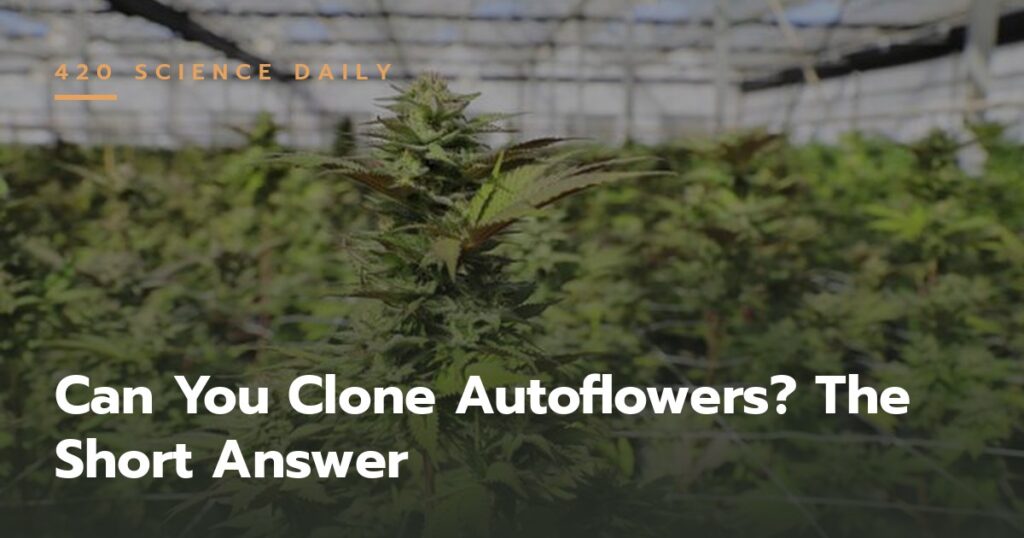
You grew an autoflower that turned out perfect — dense buds, great smell, finished fast. Naturally, you want to grow it again, exactly like that. With photoperiod plants you’d just take a cutting, root it, and keep the genetics forever. So why not do the same with your auto?
Because with autoflowers, the cutting doesn’t start over. It picks up exactly where the mother plant left off — and the mother plant is already counting down to harvest.
The short answer
Technically you can take a cutting from an autoflower, but it’s not worth doing. A clone is the same biological age as the mother plant it came from. Autoflowers flower based on age, not light cycle, so the clone keeps the mother’s schedule: it will start flowering within days or weeks of being cut, long before it has grown into a real plant. The result is a miniature plant that yields a fraction of what the mother produced.
If you want to preserve genetics through cloning, grow photoperiod strains instead — their clones can be kept in vegetative growth indefinitely. For autoflowers, the honest answer is simpler: buy more seeds of the same strain.
Why cloning works so well on photoperiod plants
To understand why autoflowers are the exception, it helps to see why cloning is the backbone of photoperiod growing.
A photoperiod cannabis plant stays in vegetative growth for as long as it gets long days — typically 18 hours of light and 6 of darkness. It only starts flowering when the light cycle shortens to around 12/12. That gives the grower total control over timing.
This control is what makes cloning possible:
- Mother plants. A grower can keep one prized photoperiod plant in veg forever, taking cuttings from it for years. The mother never flowers, so there’s always fresh material.
- Clones reset. A cutting taken from a photoperiod plant in veg stays in veg under 18/6 light. It roots, grows into a full-sized plant, and only flowers when the grower flips the lights. The clone gets a complete, normal life cycle.
- Zero genetic drift. Every clone is a genetic copy, so the tenth generation smokes exactly like the first — no seed lottery.
This is standard practice in commercial and home growing alike, and it’s the reason “clone-only” elite strains exist.
Why autoflowers play by different rules
Autoflowers inherited their defining trait from Cannabis ruderalis, a hardy northern variety that evolved where summers are too short to wait for the days to shorten. Instead of watching the light cycle, ruderalis — and the autoflowering hybrids bred from it — flowers based on age, typically switching from vegetative growth to bloom about three to four weeks after germination, regardless of how much light they receive (Small, 2015; Small, 2018).
That day-neutral internal clock is the whole problem for cloning. A cutting doesn’t reset the clock. Plant biologists and generations of growers agree on the mechanism: the cutting is the same tissue, at the same developmental stage, as the branch it was cut from. Take a cutting from a four-week-old autoflower and you don’t get a baby plant — you get a four-week-old plant with no roots, already sliding into flower.
Two more factors make it worse:
- Stress. Taking cuttings wounds the plant, and rooting takes energy. Photoperiod clones have unlimited veg time to recover. An autoflower has no spare time — every stressed day is a day stolen from its few weeks of growth.
- Size. Autoflowers are compact to begin with, so there are fewer good branches to cut from, and each cutting is proportionally a bigger loss to the mother.
What actually happens when you clone an autoflower
Growers who try it anyway report a remarkably consistent story:
- You take a healthy cutting and put it in a humidity dome with rooting hormone.
- If it roots at all, it does so slowly — often taking a week or more.
- Meanwhile the internal clock keeps ticking. The cutting starts showing pistils and flowering within days of rooting, sometimes before roots are even established.
- It never grows. What you harvest, weeks later, is essentially the cutting itself with a small bud on top — a plant a few inches tall, yielding a token amount.
Nobody disputes that a cutting can root. The dispute is whether the result deserves the name “plant.” For nearly every grower, the answer is no: the same effort put into germinating a fresh seed produces many times the harvest.
Autoflower clone vs photoperiod clone
| Autoflower clone | Photoperiod clone | |
|---|---|---|
| What triggers flowering | Age (internal clock) | Light cycle (grower-controlled) |
| Clone’s biological age | Same as mother — no reset | Resets to veg under 18/6 |
| Mother plant possible | No — she flowers on schedule | Yes — keep her in veg indefinitely |
| Time to recover from cutting stress | Almost none (3–4 week veg total) | Unlimited |
| Typical result | Tiny plant, flowers immediately | Full-sized plant, normal harvest |
| Worth doing? | No | Yes — industry standard |
Is there any trick that makes it work?
You’ll find growers online who insist they’ve cracked it. The most common claim is a narrow timing window: take cuttings only from the lowest branches, very early, before flowering hormones from the apical meristem fully reach the lower tissue — supposedly buying the cutting a few extra days of vegetative growth.
Be honest with yourself about what this is: an experiment, not a technique. Even its proponents describe a window “a few hours long” and results that merely approach the mother’s size in the best case. Nobody has published a repeatable method, and the underlying biology — the clock doesn’t reset — hasn’t changed.
Two related myths worth killing:
- “You can reveg an autoflower after harvest.” No. Revegging works by putting a harvested photoperiod plant back under 18/6 light so it returns to vegetative growth. An autoflower doesn’t respond to light cycles that way — once it has flowered, it’s done.
- “Just take the cutting really early.” A cutting from a two-week-old autoflower is still a two-week-old plant. It will flower at week three or four like everything else, except now it’s also recovering from being severed. Earlier is marginally better, but marginally better than terrible is still terrible.
What to do instead
If you love a specific autoflower strain: buy more seeds. Reputable breeders sell stable autoflower lines, and a fresh seed will out-yield any clone attempt by an order of magnitude. Seeds are the autoflower’s natural reproduction method — work with the plant’s biology instead of against it.
If you want to preserve one special plant forever: switch to photoperiods for your keepers. Grow your autoflowers for speed and simplicity, and keep a separate small photoperiod mother plant — even a single plant under a modest light — as your genetic library. Take clones whenever you want; she’ll wait.
If you’re short on space: remember that a photoperiod mother doesn’t need a big tent. A 2×2-foot space with a low-wattage light is enough to maintain a mother and root cuttings. Many growers run autos in the main tent and keep one mother tucked in a corner.
The underlying lesson is the same one that runs through all of growing: the best results come from understanding what the plant wants to do and cooperating with it. Autoflowers want to live fast and finish young. Let them.
FAQ
Can you clone autoflowers?
Technically yes — a cutting can root — but practically no. The clone keeps the mother plant’s biological age and flowers on her schedule, so it stays tiny and yields very little. For autoflowers, seeds are the way to repeat a grow.
Why do autoflower clones stay so small?
Because they never get a vegetative phase of their own. A photoperiod clone roots and then grows for as long as you keep the lights at 18/6. An autoflower clone is already counting down to flower from the day it’s cut, so it blooms while it’s still cutting-sized.
Can you reveg an autoflower?
No. Revegging means returning a harvested plant to vegetative growth with long light hours, and it only works on photoperiod plants. Autoflowers flower based on age, not light cycle, so there’s no light trick that brings them back.
What’s the best way to preserve autoflower genetics?
Buy more seeds of the same strain from a reputable breeder. Cloning can’t preserve autoflower genetics the way it does for photoperiods, so seeds — the plant’s natural reproduction — are the reliable route. If keeping a specific plant alive indefinitely matters to you, grow it as a photoperiod instead.
Can you take clones from a flowering photoperiod plant?
Yes — this is called monster-cropping, and it works because photoperiod plants can be reverted to veg under 18/6 light. The clones grow unusually bushy. But this is a photoperiod-only trick; it doesn’t transfer to autoflowers.
Sources
- Small, E. (2015). Evolution and Classification of Cannabis sativa (Marijuana, Hemp) in Relation to Human Utilization. The Botanical Review, 81, 189–294. — the standard botanical reference on C. ruderalis and its day-neutral, autoflowering habit.
- Small, E. (2018). Dwarf germplasm: the key to giant Cannabis crops. Genetic Resources and Crop Evolution, 65, 1071–1107. — documents how the day-neutral (“autoflowering”) trait from ruderalis-type plants has been transferred into modern breeding lines.







1 response to “Can You Clone Autoflowers? The Short Answer and Why”