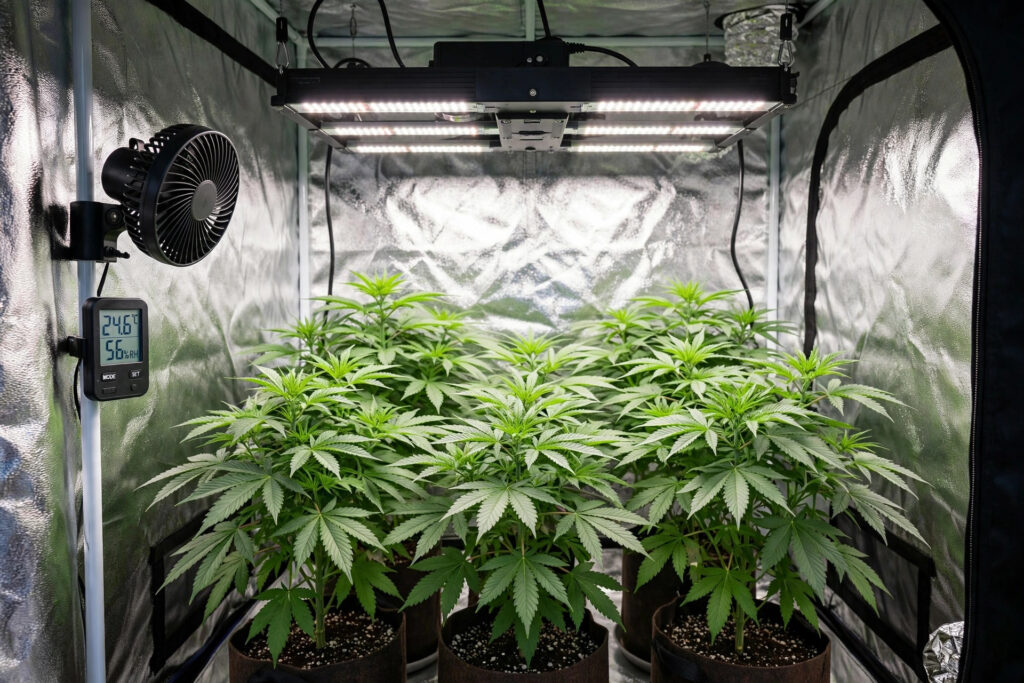
You walk into your grow tent and the top leaves are folding upward at the edges — like tiny canoes, or tacos. Before you reach for the nutrient bottles, stop. This is usually not a deficiency. It’s your plant’s built-in sunshade reflex, and it’s telling you something specific about your environment.
The short answer
Tacoing is when cannabis leaf edges curl upward and inward. The plant is deliberately shrinking the leaf surface exposed to intense light or heat. The #1 cause is lights too close or too intense; #2 is heat plus dry, still air.
Check your light distance and canopy temperature first. Reach for nutrients last.
What tacoing looks like (and what it isn’t)
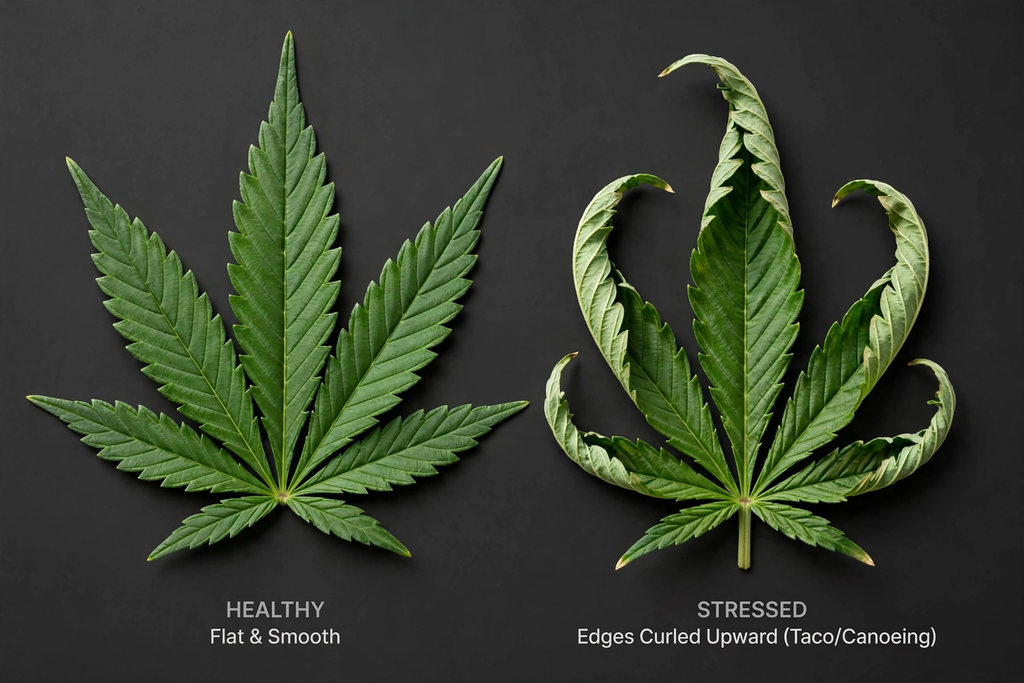
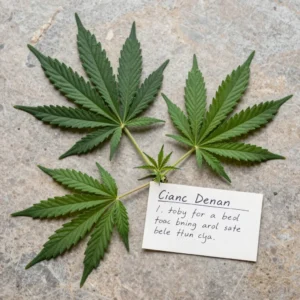
- Tacoing: edges fold upward, leaf forms a canoe/taco. Starts on the upper leaves closest to the light.
- Nitrogen-toxicity “claw”: leaf tips curl downward like claws. Different direction, different problem.
- Heat wilt: the whole leaf goes limp and droopy, not folded.
- Light burn: often arrives with tacoing — bleached or yellowing patches on the same top leaves.
Location is the diagnosis. Light stress hits the top first, right under the fixture. Nutrient problems almost always start in the lower, older foliage and work upward. If only the canopy is tacoing, it’s environmental — not nutritional.
Why plants do this: the quick science
A leaf is a solar panel. When light intensity or heat exceeds what the plant can process, it folds its panels partially closed — less surface area facing the blast means less photon overload and less water loss through the leaf. It’s a protective reflex, not damage itself. But it is a warning light on your dashboard: ignore it long enough and real damage follows.
Cause #1: Light stress (the usual suspect)
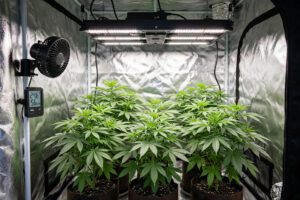
This is behind most tacoing cases, especially indoors. If the curling appeared within a day or two of moving lights closer, upgrading to a stronger fixture, or flipping to flower under intense light — that’s your answer.
Rough starting distances (adjust for your exact fixture and wattage):
- LED panels: 18–36 inches from the canopy
- HPS bulbs: 24–48 inches from the canopy
Fix: raise the light a few inches or dim it 10–20%, then watch the leaves for 24–48 hours. Tacoing from light stress visibly relaxes once the intensity drops.
Cause #2: Heat and dry, still air
Warm air amplifies everything. When canopy temperature climbs past roughly 82–85°F (28–29°C), leaves start cupping to conserve moisture — and if the air is also dry and motionless, the effect multiplies.
Fixes:
- Put a thermometer at canopy level (not on the tent wall — the top of the plant can be 5+ degrees hotter).
- Run exhaust so hot air doesn’t pool above the canopy, plus a gentle oscillating fan for air movement.
- The back-of-your-hand test: hold it at canopy height under the light. If it feels hot on your skin, it’s too hot for the leaves.
Less common causes (check these last)
- Nitrogen toxicity or phosphorus deficiency can produce similar upward curling — but they rarely start at the very top alone. If lower leaves are also affected, investigate nutrients and pH. You can check cannabis deficiencies chart.
- Overwatering and root problems almost never cause upward tacoing; they cause drooping instead. If leaves are both tacoing and drooping, you may have two problems.
How to fix tacoing — step by step
- Check light distance. Measure from fixture to the tallest cola. Raise 2–4 inches if you’re at the close end of the range.
- Check canopy temperature. Aim for 70–80°F (21–27°C) at the tops during lights-on.
- Fix airflow. Exhaust out the top, gentle breeze across the canopy — leaves should flutter slightly, not thrash.
- Do the hand test. Uncomfortably warm on your skin = too close/hot.
- Only then consider nutrients. If the tacoing is isolated to the top, skip the bottles. If lower growth shows symptoms too, check pH and feeding.
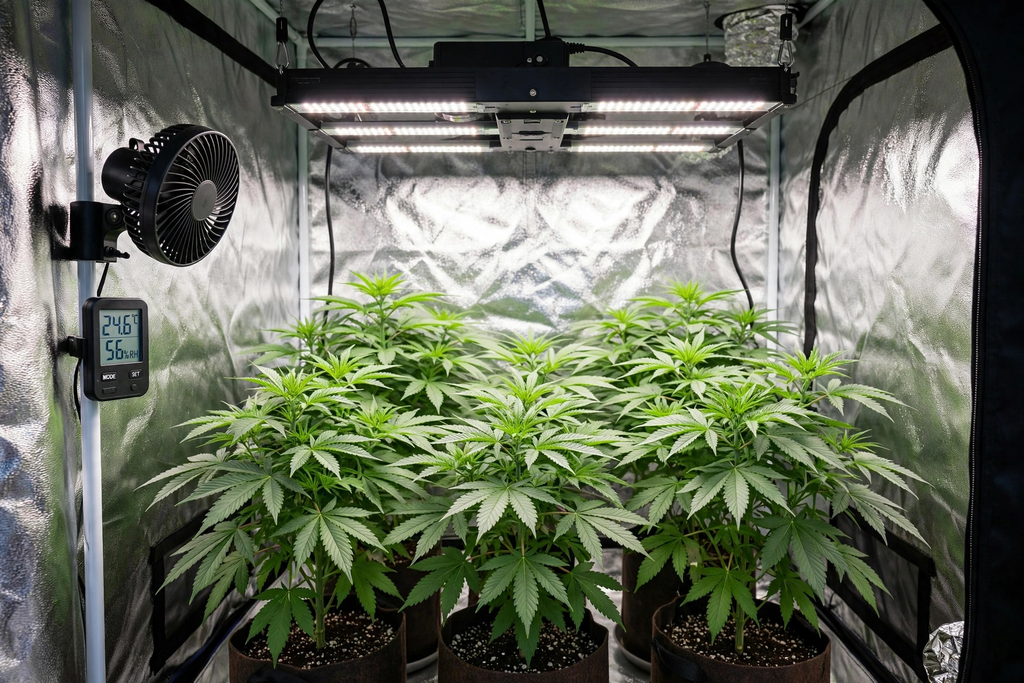
One pro tip worth remembering: healthy, well-fed plants tolerate higher light levels. If pH or nutrition is already off, the plant tacos sooner. Fix the basics and you can often run lights closer for bigger yields without stress.
Will tacoed leaves recover?
Usually, yes — leaves gradually flatten over a few days once the stress is removed, and new growth comes in completely normal. But there’s a limit: prolonged, ignored light/heat stress crisps leaf edges permanently and can suppress bud development and cannabinoid production even after you fix the environment. Early action is the whole game.
Prevention checklist
- Hang lights at the manufacturer’s recommended height; change distance gradually, never in big jumps.
- Keep a thermometer/hygrometer at canopy level, not at tent-wall level.
- Increase light intensity step by step when entering flower, watching the top leaves as your gauge.
- Keep pH and nutrition dialed in — a healthy plant handles more light.
Frequently asked questions
Is leaf tacoing bad for my plants?
The curling itself is a defense reflex, not damage. But it’s an early warning — left uncorrected, the same stress causes bleaching, crispy edges, and reduced yields.
What’s the difference between tacoing and light burn?
Tacoing is the curling (the warning); light burn is the bleached/yellow tissue damage that follows if you ignore it. They often appear together on the same top leaves.
Can tacoed leaves go back to normal?
Yes, in most cases they flatten within days of fixing the light distance or temperature. New growth will be unaffected.
Does tacoing happen outdoors too?
Less often — outdoor plants get natural light variation and airflow. When it happens outside, it’s usually an extreme heat wave, not light intensity.
My leaves taco only in flower. Why?
Flowering demands the most intense light, so fixtures often end up closest to the canopy right when buds are forming. Raise lights slightly as colas stretch upward.
Sources / further reading
- Neurolaunch — Prevent Cannabis Light Stress: Tacoing Leaves: https://neurolaunch.com/cannabis-leaves-tacoing/
- Kannabia — How to Read a Young Plant’s Body Language: https://www.kannabia.com/blog/how-to-read-a-young-plants-body-language-before-problems-arise
- Green Avenger Seeds — Cannabis Plant Dying from the Top Down (light burn vs deficiencies): https://www.greenavengerseeds.com/why-are-my-cannabis-plant-dying-from-the-top-down/
Educational content only — not medical advice. Cannabis laws vary by region.